Blog

  • The Two Ways Planets See: A Beginner’s Guide to Aspects in Vedic Astrology

    The Two Ways Planets See: A Beginner’s Guide to Aspects in Vedic Astrology

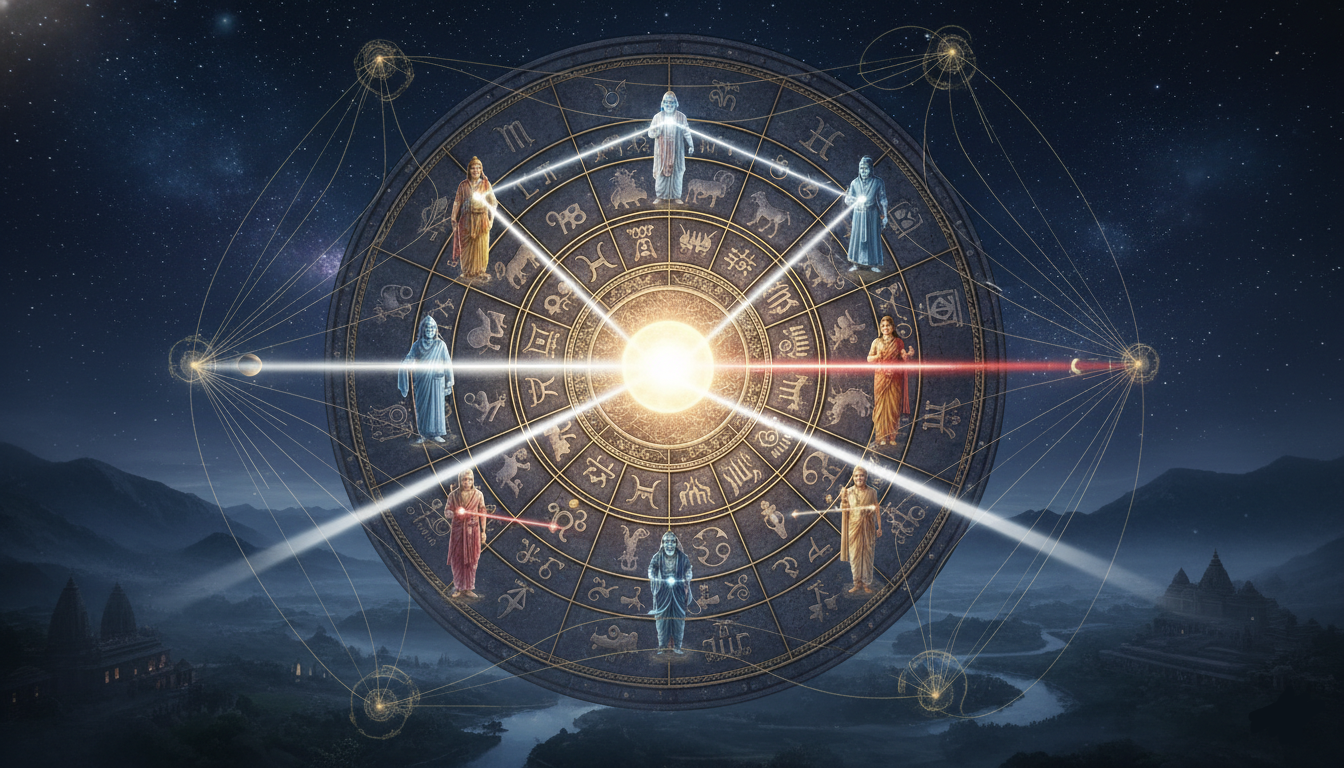
    In Vedic astrology, planets don’t just sit quietly in their signs. They are active forces that look at, influence, and interact with other parts of your chart. This “gaze” is called an aspect, or Drishti.

    Understanding aspects is like unlocking a new dimension in your birth chart. It shows you the hidden lines of force, revealing which areas of your life are in constant conversation, where you feel pressure, and where you receive support.

    Vedic astrology uses two brilliant and distinct systems of aspects. Think of them as two different kinds of influence: a direct, personal gaze and a broader, environmental network. Let’s explore both.


    1. Planetary Aspects (Graha Drishti): The Direct Gaze

    This is the most common type of aspect. It’s the direct, focused line of sight that a planet projects from its own position. Imagine a person in a room—they can look directly at others, sending a clear and potent signal.

    A key concept here: this “gaze” covers the entire sign or house it lands in. It’s not limited to an exact degree, which is a key difference from some other astrological systems.

    The rules are simple and elegant:

    A) The Universal Aspect:

    • All planets cast a full aspect on the 7th house/sign from where they are sitting. This is the energy of direct relationship, opposition, and partnership.

    B) The Special Aspects:
    Three planets have “special forces” and can cast additional full aspects, giving them a much wider reach and influence in your chart.

    • 🪐 Saturn (The Taskmaster): In addition to the 7th, Saturn also aspects the 3rd and 10th houses from its position. Its gaze brings themes of discipline, responsibility, hard work, and reality checks to those areas.
    • 🧠 Mars (The Warrior): In addition to the 7th, Mars also aspects the 4th and 8th houses. Its gaze brings energy, action, challenge, and the drive to protect or investigate.
    • Jupiter (The Guru): In addition to the 7th, Jupiter also aspects the 5th and 9th houses. Its gaze brings wisdom, opportunity, grace, and expansion.

    A Note for Western Astrology Students: If you’re used to working with “orbs” (where an aspect is only active within a few degrees), you can set that idea aside here. In Vedic astrology, if a planet aspects a sign, it influences the entire 30-degree sign and any planets within it, regardless of their specific degree.

    How to Use It: Planetary aspects show you where a planet is applying direct psychological pressure or support. The house receiving the aspect will be strongly influenced by the nature of the planet looking at it.


    2. Sign Aspects (Rashi Drishti): The Environmental Network

    This is a different and fascinating layer of influence. Instead of coming from the planet, this aspect comes from the sign itself. Think of it not as a person’s gaze, but as the architecture of the room—certain signs are built with windows that look out onto other specific signs.

    Any planet located in a sign gets to use that sign’s “windows” to see and influence others. The rules are based on the sign’s modality:

    • Movable Signs (Aries, Cancer, Libra, Capricorn): These are the initiators. They aspect all Fixed signs (Taurus, Leo, Scorpio, Aquarius), except for the one right next door.
    • Fixed Signs (Taurus, Leo, Scorpio, Aquarius): These are the sustainers. They aspect all Movable signs (Aries, Cancer, Libra, Capricorn), except for the one right next door.
    • Dual Signs (Gemini, Virgo, Sagittarius, Pisces): These are the adapters. They aspect all other Dual signs.

    How to Use It: Sign aspects reveal the broader networks and structural relationships in your chart. They show how different life themes (represented by the signs) are fundamentally linked, creating a narrative that planets within them participate in.


    Let’s See It in Action: A Simple Example

    Imagine you have Saturn in Capricorn in your chart.

    1. Planetary Aspects (The Direct Gaze):
      • Saturn looks across to the 7th sign (Cancer).
      • It also casts its special aspects on the 3rd sign (Pisces) and the 10th sign (Libra).
      • The Story: Saturn is applying direct pressure, discipline, and structure to the life areas represented by Cancer, Pisces, and Libra.
    2. Sign Aspects (The Environmental Network):
      • Capricorn is a Movable sign. It aspects all Fixed signs (Taurus, Leo, Scorpio), skipping its neighbor Aquarius.
      • The Story: The themes of Capricorn (hard work, ambition) are structurally linked to the themes of Taurus (resources), Leo (authority), and Scorpio (transformation). Your Saturn in Capricorn is part of this larger network of stability and power.

    By reading both, you get a 3D picture: Saturn is applying direct, focused pressure on certain areas, and it’s doing so from within a broader network that connects it to other key themes in your life.


    Quick Cheat Sheet

    Bookmark this for easy reference!

    Aspect TypeWhat It ShowsKey Rules
    Planetary AspectsThe planet’s personal will and direct focus.All planets see the 7th. Mars adds 4/8. Jupiter adds 5/9. Saturn adds 3/10.
    Sign AspectsThe sign’s built-in network and environmental connections.Movable ↔ Fixed (skipping neighbors). Dual ↔ Dual.

    Final Thought: Two Lenses for a Richer View

    Planetary aspects and sign aspects aren’t competing systems; they are two complementary lenses that give you a richer, more nuanced understanding of your chart.

    • Planetary aspects show you the psychological force—what a planet actively wants to influence.
    • Sign aspects show you the structural field—the environment and networks that a planet works within.

    By learning to see both, you move from a flat, 2D map of your life to a dynamic, interconnected, 3D world.

  • Persona: The Mask You Wear—and Why It Matters More Than You Think

    Persona: The Mask You Wear—and Why It Matters More Than You Think

    At work, you might be the confident, organized leader. With your family, you’re the caring, supportive one. Online, you’re witty and well-informed. We all have these different “faces” we present to the world.

    Are these faces fake? Not necessarily. In fact, according to the psychiatrist C.G. Jung, they are an essential part of being a functional human. He called this social mask the persona.

    In Jung’s terms, the persona is a social compromise—a role-based interface between you and the world. It’s contextual and adjustable; the point is to use it without becoming it. The persona forms in response to collective expectations—it’s a negotiated “uniform” that lets you take part in social life without revealing your whole psyche.

    “The persona is that which in reality one is not, but which oneself and others think one is.” — C.G. Jung


    Why You Absolutely Need a Persona

    It’s tempting to think that “authenticity” means having no mask at all, but a healthy persona is actually a sign of psychological maturity. Here’s why it’s so important:

    • It Creates Social Harmony: Knowing how to act in a library versus at a party reduces friction and helps everyone feel comfortable.
    • It Provides Role Clarity & Predictability: The way you speak to your boss is different from how you speak to your child, and that clarity is what makes both relationships work.
    • It Protects Your Energy: Your persona acts as a healthy boundary, allowing you to function in the world without having to expose every vulnerable part of your psyche to everyone you meet.

    Authenticity isn’t total transparency; it’s value-consistent behavior across different contexts.


    When the Mask Becomes a Cage

    Problems arise when we forget that the persona is a tool and start believing it’s our entire identity. This can happen in two ways.

    1. The Mask Is Too Tight (Over-Identification)

    This is when you can’t take the mask off. You’re “on” all the time, constantly performing your role.

    • Signs: You feel exhausted from being the “perfect” parent or the “always-on” leader. Feedback to the role feels like total self-annihilation. You’ve lost touch with your messy, authentic feelings.

    2. The Mask Is Too Loose (Under-Developed)

    This is when you lack a functional mask, leading to social friction.

    • Signs: You might overshare with colleagues or struggle to read social cues. You get feedback that you’re “unprofessional” or “inconsistent,” even if your work is brilliant. You might also blur private/public boundaries online, posting vulnerabilities without containment and regretting it later.

    The Persona and the Shadow: Two Sides of the Same Coin

    Your persona and your shadow have a fascinating relationship.

    • The Persona is everything you consciously present to the world.
    • The Shadow is everything you hide because it doesn’t fit the persona.

    If your persona is the “nice, easygoing” one, your shadow might be holding your anger, ambition, and firm boundaries. Not all shadow comes from the mask itself—family taboos, shame, and trauma also exile traits. A flexible persona reduces this exile; a rigid one enlarges it.

    True growth isn’t about destroying the mask; it’s about making it more flexible so you can integrate the healthy, necessary parts of your shadow.


    How to Tune Your Persona: 3 Simple Practices

    Is your persona serving you? A healthy mask is one that is both flexible and authentic. Here are a few ways to check in and make adjustments.

    1. Anchor in Your Core Values

    Your persona can and should change depending on the context, but your core values should not.

    • Practice: Choose three words that represent your absolute core values (e.g., “Clarity, Kindness, Integrity”). Let these values be the anchor for every persona you wear. You can be a kind leader, a kind parent, and a kind friend. The style changes, but the core remains.

    2. Create a “Demasking” Ritual

    It’s crucial to have a way to signal to your nervous system that the performance is over.

    • Practice: Create a simple ritual to transition out of your work persona. It could be changing your clothes, taking a five-minute walk around the block, or simply taking three deep breaths and consciously saying, “I’m home now.”

    3. Practice “Shadow Sampling”

    Gently reintroduce a trait that your persona has excluded.

    • Practice: If your persona is always serious and professional, find a safe, low-stakes way to express 1% of your playful side this week. Tell a joke in a team meeting. Share a silly meme. This helps make your mask more flexible and whole.

    Final Thought: A Skillful Mask Protects Your Soul

    The goal of a healthy life isn’t to live without a mask. It’s to have a wardrobe of masks, each one chosen consciously and anchored in your true values.

    A well-fitting persona doesn’t hide who you are; it protects your deep, authentic self from unnecessary wear and tear. It allows you to navigate the world with skill, grace, and integrity, saving your truest, most vulnerable self for the people and places that have earned your trust.

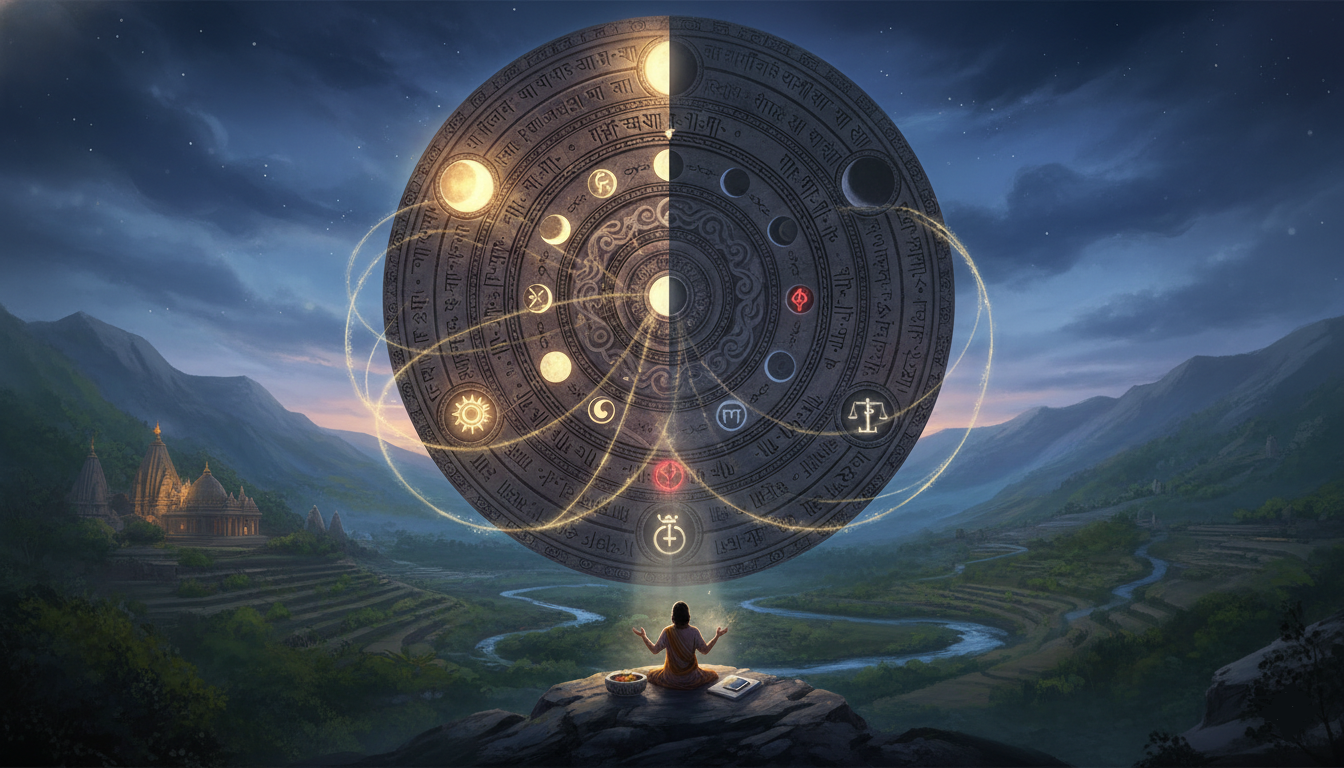
  • The 5 Elements of a Vedic Day: Your Guide to the Panchanga

    The 5 Elements of a Vedic Day: Your Guide to the Panchanga

    Ever have one of those days where you feel totally in flow? The meeting you scheduled goes perfectly, your creative ideas land, and you get more done in a few hours than you did all last week. Then there are other days where every task feels like a struggle.

    What if there was a way to understand the unique energy of each day before it even begins?

    In Vedic tradition, there is. It’s called the Panchanga.

    The Panchanga (from the Sanskrit pancha-anga, meaning “five limbs”) is the ancient Vedic calendar. It’s like a daily cosmic weather report that describes the quality of time, helping you align your actions with the flow of the universe.

    Ancient Wisdom, Modern Application

    This guide blends the classical definitions of the Panchanga with contemporary, practical ways to use them for everyday planning. While traditionally used for timing important ceremonies, this framework is also a powerful tool for modern productivity and self-awareness. For formal events like weddings or vows, it’s always best to consult your family tradition and a qualified astrologer.


    1. Tithi (The Lunar Day): The Rhythm of Momentum

    What it is: The Tithi tracks the Moon’s journey away from the Sun. There are 30 Tithis in a lunar month—15 during the waxing phase (Shukla Paksha) as the Moon grows brighter, and 15 during the waning phase (Krishna Paksha) as it darkens.

    How to use it:

    • Waxing Moon (growing bigger): The energy is building. This is a supportive time for starting new projects, growth, and expansion.
    • Waning Moon (getting smaller): The energy is contracting. This is perfect for finishing tasks, editing, refining, and letting go.

    A Deeper Look: Technically, a Tithi marks each 12-degree increment of distance between the Sun and Moon. Because the Moon’s speed changes, a Tithi’s duration can vary, lasting anywhere from 19 to 26 hours.


    2. Vara (The Weekday): The Manager of the Day

    What it is: The Vara is the day of the week, ruled by a specific planet. Each planetary ruler sets the “managerial tone” for the day.

    How to use it: Aligning your tasks with the day’s planetary energy is a simple but powerful practice.

    DayRulerA Supportive Time For…
    SundaySunLeadership, setting goals, visibility, self-care.
    MondayMoonCommunity, nurturing, planning, connecting.
    TuesdayMarsTaking action, tackling hard tasks, exercise.
    WednesdayMercuryCommunication, learning, writing, data analysis.
    ThursdayJupiterStrategy, teaching, finances, big-picture thinking.
    FridayVenusCreativity, relationships, marketing, enjoyment.
    SaturdaySaturnDeep work, organizing, cleaning, long-term tasks.

    3. Nakshatra (The Lunar Mansion): The Soul of the Day

    What it is: This is the heart of the Panchanga. The Nakshatras are the 27 star constellations, or “lunar mansions,” that the Moon passes through. The Nakshatra the Moon is in today describes the day’s core archetype, mood, and personality.

    How to use it: Think of the Nakshatra as the day’s unique “character.” To give you a feel for their personalities, here are a few examples from the full system of 27:

    • Rohini: Creative and growth-oriented, supportive for planting seeds, starting a business, or launching a product.
    • Pushya: Known for its nourishing quality, its energy is ideal for learning, teaching, and acts of service.
    • Ashwini: Swift and healing, its energy is great for starting a new health routine or getting a quick start on a project.

    4. Yoga (The Energetic Filter): The Tone of the Day

    What it is: The Yoga is a special calculation based on the combined positions of the Sun and Moon. There are 27 Yogas, and they act like an energetic filter for the day.

    Yoga is computed as ((Sun longitude + Moon longitude) mod 360°) ÷ 13°20′, producing one of 27 nitya yogas. Traditions rate them differently; many are neutral-to-supportive, while several are cautionary. Vyatipata and Vaidhriti are widely treated as inauspicious for auspicious beginnings. On such days, favor introspection, planning, maintenance, or removals over inaugurations.


    5. Karana (The Micro-Timing): The “Go” Signal

    What it is: The Karana is the smallest unit, representing half of a Tithi. It provides a final layer of nuance for timing your actions within the day. For example, the Vanija karana has commerce connotations, and many practitioners find it supportive for business—not a guarantee, but a useful tie-breaker.

    The 7 movable karanas cycle in order—Bava → Balava → Kaulava → Taitila → Gara → Vanija → Vishti (Bhadra)—repeating eight times per lunation. The 4 fixed karanas occur once each month at specific halves: Kimstughna (Shukla Pratipada 1st), Shakuni (Krishna Chaturdashi 2nd), Chatushpada (Amavasya 1st), Naga (Amavasya 2nd).

    Vishti (Bhadra) is generally avoided for auspicious inaugurations; it’s powerful for obstacle-clearing, audits, and tough clean-ups.


    A Quick Note: Why Panchanga Apps Disagree

    You might notice that one app gives slightly different timings than another. This is normal! Different systems use different astronomical calculations (ayanamsas) or define the day differently. Traditional panchangas reckon the day from local sunrise to the next sunrise, so vara, tithi, yoga, and karana may change within the civil day. Modern apps that anchor to midnight can show different boundaries. The key is to pick one reliable source and stay consistent with it.


    Putting It All Together: A Simple Daily Practice

    1. Get a Panchanga App: Find one that feels clear to you.
    2. Check the Vitals: In the morning, take 60 seconds to look at the day’s Tithi, Vara, and Nakshatra.
    3. Align One Action: Choose just one thing on your to-do list that feels perfectly aligned with the day’s energy.

    What If the Factors Conflict?

    A good rule of thumb is to prioritize the day’s energy in this order: Nakshatra (the core story) → Tithi (the momentum) → Karana (the start moment). If a challenging Yoga is active, consider down-scoping your plans rather than canceling them.


    Final Thought: Time Isn’t Just a Clock

    The Panchanga teaches us that time isn’t a flat line. It has texture, quality, and personality. By learning to read this ancient map, you empower yourself to make wiser choices, reduce friction, and live a life that is more in tune with the beautiful, complex rhythm of the universe.

  • Why Little Things Feel So Big: A Guide to Emotional Triggers in Your Relationships

    Why Little Things Feel So Big: A Guide to Emotional Triggers in Your Relationships

    Have you ever had a tiny moment in a relationship feel disproportionately huge? Your partner replies with a one-word text, and you spiral into anxiety. Your friend changes plans last minute, and you’re filled with a surprising amount of rage.

    These moments are often called emotional or relational triggers. In this article, we’ll use the term “shadow triggers” as a simple teaching frame to explore them through a Jungian lens.

    The psychiatrist C.G. Jung described the “shadow” as the parts of ourselves we’ve disowned or can’t consciously identify with. A shadow trigger is a present-day moment that pokes that hidden material—unleashing an emotional reaction that’s often far bigger than the situation itself. These moments often involve a cocktail of psychological dynamics:

    • Projection: A concept from early psychoanalysis where we see our own unacknowledged traits in others.
    • Complexes: A core Jungian idea describing emotionally charged themes (like worth or abandonment) that can hijack our responses.
    • Transference: A term from psychoanalysis where we relate to a current person as if they were someone from our past.

    Understanding your triggers isn’t about blaming yourself for being “too sensitive.” It’s about seeing them as signposts, pointing you toward the parts of yourself that are ready to be understood and healed.


    12 Common Triggers and What They’re Really About

    Triggers are rarely about the thing itself; they’re about the old story the thing activates. Here are 12 common examples.

    1. Being Ignored or Delayed Replies:
      • The Deeper Nerve: A fear of abandonment or a feeling of unworthiness.
    2. Last-Minute Plan Changes:
      • The Deeper Nerve: A feeling of powerlessness or a reactivation of childhood unpredictability.
    3. Receiving Constructive Feedback:
      • The Deeper Nerve: A core belief of being defective or a fear that you must be perfect to be loved.
    4. Getting a Compliment:
      • The Deeper Nerve: This often points to the “golden shadow”—a post-Jungian idea popularized by Robert A. Johnson, which refers to positive strengths you’ve disowned.
    5. Your Partner’s Success:
      • The Deeper Nerve: Envy and a fear of being left behind.
    6. Talking About Money:
      • The Deeper Nerve: Deep-seated fears around security, power, and fairness.
    7. Mismatched Libidos or Desire:
      • The Deeper Nerve: A profound fear of rejection or shame.
    8. Jealousy:
      • The Deeper Nerve: Old wounds of betrayal or a pattern of self-comparison.
    9. Unfair Division of Labor:
      • The Deeper Nerve: A feeling of being invisible or taken for granted.
    10. Silence or Withdrawal:
      • The Deeper Nerve: A fear of emotional neglect or a feeling that conflict is unsafe.
    11. Different Social Needs (Introvert vs. Extrovert):
      • The Deeper Nerve: The fear of being “too much” or “not enough.”
    12. Phone/Tech Boundaries:
      • The Deeper Nerve: A feeling of unworthiness—that you are less interesting than a screen.

    How to Work With Your Triggers: A Practical Loop

    The next time you feel that emotional surge, don’t just react. Pause and get curious.

    Before You Start: Is It Just a Trigger?

    Disproportionate reactions can arise from many sources. Before diving into shadow work, check in: Is your reaction also influenced by physiology (sleep debt, hunger), attachment injuries, past trauma, or even neurodivergence? This guide is for exploring patterns, not for self-diagnosing.

    1. Name the Facts: What actually just happened, without any story? (e.g., “My partner looked at their phone while I was talking.”)
    2. Name the Feeling: What emotion came up for you? (e.g., Sadness, anger, loneliness.)
    3. Spot the Story: What story did you immediately tell yourself? (e.g., “They don’t care about what I’m saying.”)
    4. Find the History: Where is this feeling or pattern familiar from your past?
    5. Make a Clear Request or Boundary: Based on your need, what is one clear, kind, and specific thing you can ask for?

    A Note on Safety: When to Seek Professional Support

    While this framework is powerful for everyday triggers, it’s crucial to distinguish them from responses to real harm. If your reaction is to disrespect, coercion, or abuse, the issue is not your shadow—it’s the other person’s behavior.

    Disproportionate reactions can arise from many sources. If triggers are frequent, intense, or impair your work, sleep, or sense of safety, consider seeking support from a licensed, trauma-informed clinician.


    Final Thought: Your Triggers Are Your Teachers

    Your emotional triggers are not a sign that you or your partnership is broken. They are simply messengers from the deepest parts of yourself, asking for attention and healing.

    Every time you pause, breathe, and choose to respond with curiosity instead of reactivity, you are not only healing yourself—you are building a relationship strong enough to hold all of who you are, shadow and light.

  • Your “Golden Shadow”: How to Reclaim the Best Parts of Yourself You’ve Hidden Away

    Your “Golden Shadow”: How to Reclaim the Best Parts of Yourself You’ve Hidden Away

    We often think of “shadow work” as exploring our so-called dark side—our anger, our jealousy, our fear. But what if the most powerful parts of you weren’t “dark” at all, but brilliant, golden, and shining?

    Welcome to the concept of the golden shadow.

    While C.G. Jung described the shadow as everything we don’t identify with, the term “golden shadow” was popularized by later Jungian writers like Robert A. Johnson. Jung held that the unconscious contains creative, compensatory potentials—not only ‘dark’ material—on which this idea builds. The golden shadow refers to the positive qualities we’ve disowned or kept out of awareness—our confidence, creativity, leadership, and joy.

    These are the beautiful parts of ourselves that we may have learned to hide in order to fit in, be liked, or stay safe. But they are still there, waiting for you to reclaim them. Learning to work with your golden shadow is one of the most joyful and life-affirming journeys you can take.


    How to Spot Your Golden Shadow: The 3 Telltale Clues

    Your hidden gold doesn’t stay buried forever. It tries to get your attention, and it usually shows up in a few key ways.

    1. The Spark of Envy or Intense Admiration

    This is your biggest clue. When you see someone else living a life that you secretly long for and you feel a sharp pang of envy or intense, almost worshipful admiration, you’re likely meeting your golden shadow. That person is simply being a mirror, showing you a potential that is alive within you.

    A Quick Reality Check: Envy can also highlight external barriers like a lack of resources, systemic bias, or timing. It’s important to hold a both/and perspective: improve your external conditions where you can and reclaim your internal capacity.

    2. The Compliment Cringe

    Someone gives you a heartfelt compliment, and you immediately deflect it.

    • “You’re such a powerful leader.” → “Oh, it was a team effort.”
    • “This painting is beautiful!” → “It’s just a little doodle.”

    When you can’t receive praise for a certain quality, it’s often because that quality lives in your golden shadow. You haven’t yet given yourself permission to own it.

    3. Chronic Under-Statement

    You consistently downplay your achievements and soften your opinions. You have a brilliant idea in a meeting but you stay silent. This is a classic sign that you’re hiding your light.


    Why Did We Hide Our Best Parts?

    No one decides to disown their strengths consciously. We learn to do it, often for very good reasons.

    • Family & Cultural Messages: We heard things like, “Don’t brag,” “Don’t be the center of attention,” or “It’s not polite to be too ambitious.”
    • Fear of Responsibility: Stepping into our power means we become more visible, and that can be scary.
    • To Belong: At some point, fitting in felt more important than standing out. So we trimmed away the parts of ourselves that felt “too much.”

    How to Reclaim Your Gold: A Simple 3-Step Practice

    Reclaiming your golden shadow isn’t about becoming arrogant. It’s about becoming whole. It’s a gentle process of inviting these beautiful parts of yourself back into the light.

    Step 1: Turn Envy into an Invitation

    The next time you feel that spark of envy or admiration, get curious.

    1. Name the Quality: What is the specific quality you are drawn to? Is it their confidence? Their freedom? Their creativity?
    2. Find Your 1%: Spotting it vividly in others usually means it’s a value or latent capacity in you—it may be nascent, not identical in scale. Ask yourself: “Where does this quality already show up in my life, even just a little?”

    Step 2: Take One Tiny, Embodied Action

    You reclaim your power through small, consistent actions. Based on the quality you named, what is one tiny, 90-second action you can take today?

    • If the quality is confidence, can you speak up just once in a meeting?
    • If the quality is creativity, can you post one imperfect photo or write one paragraph?
    • If the quality is ease, can you say “no” to one small thing that would drain you?

    The key is to make it so small it’s almost impossible not to do. Small reps build big strengths.

    Step 3: Practice Receiving Praise

    This can be the hardest step, but it’s crucial. The next time someone gives you a compliment that touches on your golden shadow, resist the urge to deflect.

    1. Breathe.
    2. Make eye contact.
    3. Say, “Thank you.”
    4. (Advanced): Add one sentence of ownership. “Thank you. I’m really proud of how the strategy turned out.”

    A Note on Safety & Integration

    Reclaiming your power is exciting, but it’s important to do so with awareness. Remember that integration is not inflation. As you express these new strengths, match them with data, feedback, and clear boundaries to stay grounded.

    If you find that this work brings up intense shame or old trauma, be gentle with yourself. Pacing is key, and working with a licensed, trauma-informed therapist can provide a safe and supportive container for this deep and rewarding journey.


    Final Thought: Your Light is Meant to Be Shared

    Your golden shadow is not a flaw; it’s your untapped potential. The joy, the leadership, the creativity, and the confidence you admire in others are not separate from you—they are a reflection of the gold that is already within you.

    The journey of reclaiming your golden shadow is the journey of giving yourself permission to finally, fully, be yourself. And that is a gift not just to you, but to everyone around you.

  • Seeing Your Shadow in Others: A Beginner’s Guide to Projection

    Seeing Your Shadow in Others: A Beginner’s Guide to Projection

    Have you ever met someone and instantly felt that you knew who they were? Maybe you decided your new boss was a controlling micromanager after a single email, or you put a new date on a pedestal, convinced they were perfect.

    This powerful, often unconscious, mental shortcut is part of what early psychoanalysis called projection. First described by Freud and widely elaborated by C.G. Jung, projection is when something we can’t or won’t own in ourselves is experienced as if it lives out there—in another person. In close relationships, projection often blends with transference—relating to someone as if they were a figure from your past.

    It’s not a flaw; it’s a normal defense mechanism. But learning to recognize your projections is one of the most powerful things you can do for your personal growth and the health of your relationships.


    The Two Faces of Projection: Demonization and Idealization

    Projection isn’t just about the “bad” stuff. It can be a clue to both your hidden challenges and your hidden strengths.

    1. Negative Projection (Demonization)

    This is the one we’re most familiar with. It’s when you have a strong, negative, and often judgmental reaction to a trait in someone else.

    • It sounds like: “They are so arrogant/lazy/selfish/needy.”
    • What’s happening: Often, the trait that irritates you most in someone else is a disowned part of your own shadow.

    2. Positive Projection (Idealization)

    This is when you put someone on a pedestal, seeing them as flawless or possessing a quality you desperately admire.

    • It sounds like: “She’s a genius. She’s so confident and fearless.”
    • What’s happening: You are projecting your own “golden shadow,” a term popularized by later Jungian writers like Robert A. Johnson. Your admiration is a signpost pointing to a strength you are ready to reclaim.

    How to Know When You’re Projecting: The Telltale Signs

    Projection is unconscious, but it leaves clues. You might be projecting if:

    • Intensity > facts — Your emotional response feels way bigger than the situation warrants.
    • Fast certainty — You “just know” who this person is, based on very little evidence.
    • All-or-nothing — You see them as either an angel or a villain, with no room for nuance.
    • You see a repeating pattern — You keep meeting the “same” person in different bodies.
    • You experience “whiplash” — Your opinion of them flips dramatically, from idol to disappointment.

    Important Caveat: Intensity can also point to real problems like boundary violations, prejudice, or safety risks. Hold a both/and perspective: check the external facts and check for your own internal projection.


    The 3-Step Process to Reclaim Your Projections

    The goal isn’t to stop projecting—it’s to become aware of it and use it as a tool for growth. When you notice a strong projection, don’t just react. Get curious.

    Step 1: Pause and Notice the “Charge”

    The next time you feel that intense reaction—whether it’s irritation or awe—just pause. Name the feeling. Is it envy? Anger? Admiration? Get clear on the emotional energy inside of you.

    Step 2: Flip the Lens with the “1% Test”

    This is a game-changer. Ask yourself this powerful question:

    “Where do I do a tiny, 1% version of the very thing I’m judging or admiring?”

    • If you’re judging someone as “arrogant,” where could you benefit from owning 1% more of your own healthy confidence?
    • If you’re admiring someone’s “creative genius,” what is one small, 1% creative act you could take today?

    This isn’t about excusing anyone’s behavior. It’s about taking your power back.

    Step 3: Find the Need and Take Direct Action

    Your projection is a signpost pointing to an unmet need.

    • If your story is “They never appreciate me,” the underlying need is for appreciation. Your direct action could be to ask a trusted friend for feedback or to appreciate your own hard work.
    • If your story is “They’re so invasive,” the underlying need is for boundaries. Your direct action is to practice setting one clear, kind boundary.

    Owning your 1% doesn’t erase their 99%; it just gives you cleaner choices and boundaries.


    A Note on Relationships: Don’t Weaponize This!

    Learning about projection is powerful, but it’s not a weapon. Saying “You’re just projecting!” is a surefire way to shut down a conversation.

    Instead, lead with vulnerability. Own your part first.

    • Instead of: “You’re being controlling.”
    • Try: “I’m realizing I have a strong reaction when plans change. For me to feel secure, I need…”

    In abusive or coercive situations, prioritize safety, evidence, and outside support; don’t use “projection” to downplay harm.


    Final Thought: Your World is a Mirror

    Projection is the mind’s way of showing you what’s ready to be healed and integrated. It’s not a sign that you’re broken; it’s a sign that you’re ready to become more whole.

    Every person you meet, especially those who trigger you the most, is offering you a precious gift: a mirror reflecting a hidden part of yourself. The courageous work is to stop polishing the mirror and, instead, turn to look within.

  • What Is Shadow Work? A Beginner’s Guide to Meeting Your Hidden Self

    What Is Shadow Work? A Beginner’s Guide to Meeting Your Hidden Self

    Have you ever had a surprisingly intense reaction to something small? Or noticed that you keep finding yourself in the same frustrating situations, whether at work or in love? Have you ever looked at someone else’s success and felt a confusing mix of admiration and intense envy?

    These aren’t random glitches in your personality. They are clues. And they are pointing you toward one of the most profound and rewarding journeys you can take: shadow work.

    The psychiatrist C.G. Jung used the term “shadow” to describe everything we don’t—or can’t—identify with in our conscious self (the ego). It includes the traits, impulses, and memories we’ve disowned or hidden away to be liked, accepted, or safe.

    But this isn’t just about the “dark stuff” like anger or fear. Our greatest strengths can also be hidden in the shadow. Shadow work is the courageous and compassionate process of turning to meet these hidden parts, so you can live a more whole, free, and authentic life.


    How Your Shadow Shows Up in Daily Life

    Your shadow isn’t some monster lurking in the dark. It’s a pattern in your psyche that’s trying to get your attention, and it usually shows up in a few predictable ways:

    • Triggers: When you have an emotional reaction that feels way bigger than the situation warrants.
    • Projections: When you have a strong, judgmental reaction to a trait in someone else. Projections can be negative (demonization) or positive (idealization); both point back to you.
    • Repeating Patterns: When you find yourself in the same conflict or dynamic over and over again.
    • Uncomfortable Compliments: When someone praises you for a quality (like being a strong leader) and your immediate reaction is to dismiss it. This is a clue to your “golden shadow”—a strength you haven’t owned.

    A Gentle Start: Three Simple Practices for Shadow Work

    Shadow work isn’t about criticizing yourself. It’s about getting curious. The goal is integration, not elimination. Here are three simple, beginner-friendly ways to start the conversation with your hidden self.

    1. The “Trigger → Truth” Journaling Prompt

    When you get triggered, it’s a golden opportunity. Instead of reacting, grab a journal and get curious.

    1. Name the Facts: What actually happened, without any story or drama? (e.g., “My boss sent me an email at 9 PM.”)
    2. Name the Feeling: What emotion did it bring up in you? (e.g., Anger, anxiety, resentment.)
    3. Spot the Story: What story did you immediately tell yourself? (e.g., “She has no respect for my time. She expects me to work 24/7.”)
    4. Find the Need: What core need was being touched? (e.g., “The need for rest, respect, and clear boundaries.”)

    This simple process moves you from a reactive state to a place of empowered self-awareness. Now you can address the real issue—the need—instead of just reacting to the trigger.

    2. The Projection Check: Seeing Yourself in Others

    The world is a mirror. The people who provoke the strongest reactions in us are often showing us a disowned part of ourselves.

    1. Choose a Person: Think of someone you either strongly admire or strongly dislike.
    2. List Three Adjectives: Write down three words that describe what you admire or dislike about them.
    3. Find the 1% Echo: Look at the most emotionally charged word on your list. Ask yourself, gently and honestly: “Where is there a tiny, 1% echo of that trait in my own life?”

    This isn’t about condoning bad behavior; it’s about reclaiming the energy you’ve projected onto others.

    3. Reclaiming Your “Golden Shadow”

    Your shadow also contains your hidden superpowers. The term “golden shadow,” popularized by later Jungian writers like Robert A. Johnson, refers to the positive qualities you’ve disowned, often because you were taught it wasn’t safe to be that brilliant or powerful.

    • The Clue: Intense envy or admiration is your biggest clue. Who are you jealous of? What quality do they embody that you secretly long for?
    • The Invitation: Envy is just a signpost pointing toward a desire. If you’re envious of a friend’s creative courage, the invitation isn’t to resent them; it’s to take one tiny, creative risk yourself. Write one paragraph. Share one idea.

    A Note on Safety: When to Seek Support

    Shadow work can bring up deep feelings and old pain. It’s a courageous journey, but you don’t have to do it alone. If you encounter overwhelming shame, trauma responses, or feel like you’re in over your head, that’s a sign to pause and seek support. If a strong reaction lasts more than a day or two or impairs your sleep, work, or sense of safety, it’s time to reach out.

    Working with a licensed, trauma-informed therapist can provide a safe container to explore these deeper parts of yourself.


    Final Thought: Wholeness, Not Perfection

    Shadow work is not a one-and-done project. It’s a lifelong practice of compassionate self-awareness. It’s the commitment to showing up for all the disowned patterns in your psyche—the messy, the brilliant, the scared, and the brave.The goal isn’t to become a perfect person with no shadow. The goal is to become a whole person, with more choices, more compassion, and a deeper connection to the truth of who you are. And that is a journey worth taking.

  • What’s Your Inner Archetype? A Guide to the Characters Within You

    What’s Your Inner Archetype? A Guide to the Characters Within You

    Have you ever felt like different parts of you are running the show at different times? There’s the ambitious part that takes charge at work, the nurturing part that shows up for friends, and maybe even a rebellious part that wants to break all the rules.

    According to the pioneering psychiatrist C.G. Jung, you’re not imagining it. He proposed that all humans share deep, universal patterns he called archetypes—structural tendencies in the collective unconscious that shape our images, emotions, and behavior. He identified several core patterns, like the Hero, the Mother, the Trickster, and the Shadow.

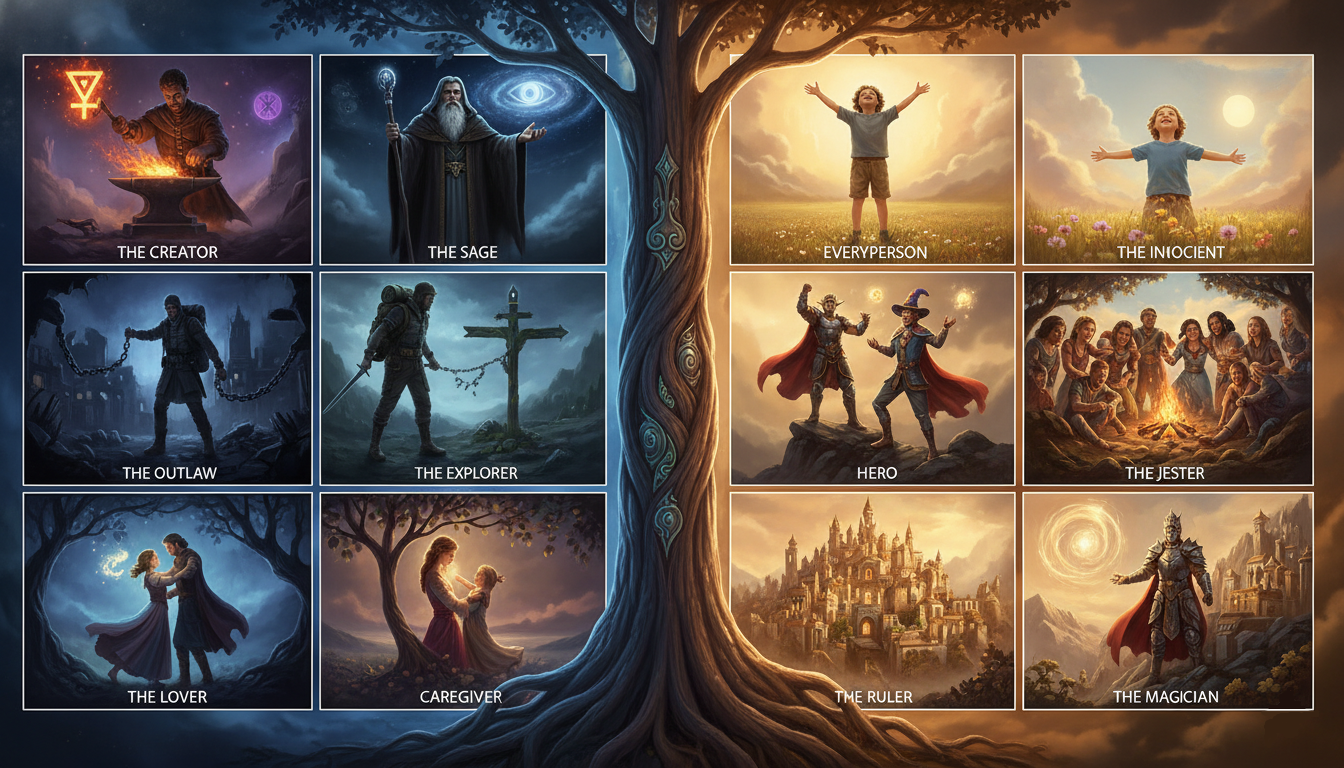
    To make these profound ideas practical, modern authors have organized them into helpful lists. A widely used 12-archetype framework comes from Jungian-influenced authors like Carol S. Pearson. This list is a brilliant teaching tool for understanding your own motivations and life stories.

    Think of these archetypes not as rigid labels, but as powerful mirrors. By recognizing which are most active within you, you can work with their strengths, navigate their challenges, and live a more whole and authentic life.


    The Archetypes of the Soul (Essence & Meaning)

    (Note: These groupings are a teaching aid for this article; they are not Jung’s original categories.)

    This group is driven by the search for truth, transformation, and creation.

    1. The Creator

    • Essence: To bring something new and imaginative into the world.
    • In the Light: You are innovative, expressive, and a natural artist or builder.
    • In the Shadow: Perfectionism—getting stuck in endless tinkering, afraid to release your work.
    • A Growth Prompt: Set a clear deadline and “ship version one.” You can always refine it later.

    2. The Sage

    • Essence: To find wisdom and understand the world.
    • In the Light: You are a truth-seeker, a researcher, and you see patterns others miss.
    • In the Shadow: “Analysis paralysis,” over-intellectualizing feelings instead of experiencing them.
    • A Growth Prompt: Translate one powerful insight into one concrete, real-world action this week.

    3. The Magician

    • Essence: To transform perspectives and create change.
    • In the Light: You are a visionary, an intuitive guide, and a catalyst for change.
    • In the Shadow: Manipulation or the promise of a “silver bullet” fix, avoiding the real work of transformation.
    • A Growth Prompt: Keep your vision grounded. What is the very next small step required to make the magic real?

    The Archetypes of the Self (Identity & Journey)

    (Note: These groupings are a teaching aid for this article; they are not Jung’s original categories.)

    This group is driven by the journey of self-discovery, freedom, and finding one’s place in the world.

    4. The Explorer

    • Essence: To experience a more authentic and fulfilling life through discovery.
    • In the Light: You are curious, independent, and adaptable. You aren’t afraid to forge your own path.
    • In the Shadow: A restless wanderer, addicted to novelty and afraid of commitment.
    • A Growth Prompt: Choose a “basecamp”—a relationship or home—to explore from. An anchor makes freedom sustainable.

    5. The Innocent (overlaps with Jung’s “Child” archetype)

    • Essence: To be happy and to trust in the goodness of life.
    • In the Light: You bring optimism, hope, and a simple, joyful faith to every situation.
    • In the Shadow: Naïveté or denial, refusing to see problems and engaging in toxic positivity.
    • A Growth Prompt: Pair your powerful hope with a practical plan. What safeguards can you put in place?

    6. The Everyperson

    • Essence: To connect with others and belong.
    • In the Light: You are empathetic, down-to-earth, and a natural community builder.
    • In the Shadow: A fear of standing out, leading you to fit in at any cost, even if it means silencing your voice.
    • A Growth Prompt: Practice sharing your unique perspective, even in a group setting.

    The Archetypes of Action (Making an Impact)

    (Note: These groupings are a teaching aid for this article; they are not Jung’s original categories.)

    This group is driven by the desire to overcome challenges, create order, and change the world.

    7. The Hero

    • Essence: To prove one’s worth through courageous acts.
    • In the Light: You are brave, disciplined, and determined. You rise to the occasion in a crisis.
    • In the Shadow: A workaholic, addicted to struggle, or focused on “saving” others to avoid their own inner work.
    • A Growth Prompt: Redefine “courage.” Sometimes, the most heroic act is to choose rest or ask for help.

    8. The Outlaw (or Rebel)

    • Essence: To break the rules that are no longer working.
    • In the Light: A revolutionary and an innovator, you have the courage to challenge the status quo.
    • In the Shadow: Destruction for its own sake, rebelling without a clear vision for what to build next.
    • A Growth Prompt: Before you tear something down, get clear on what you want to build in its place.

    9. The Ruler (overlaps with Jung’s “King” archetype)

    • Essence: To create a thriving and orderly family, community, or organization.
    • In the Light: You are a responsible leader, a systems thinker, and a great steward.
    • In the Shadow: The need to control everything, leading to rigidity and an inability to delegate.
    • A Growth Prompt: True power lies in empowering others. Delegate one meaningful outcome this week.

    The Archetypes of the Heart (Connection & Joy)

    (Note: These groupings are a teaching aid for this article; they are not Jung’s original categories.)

    This group is driven by the need for love, laughter, and service.

    10. The Lover

    • Essence: To be in relationship with the people, work, and surroundings they love.
    • In the Light: You are passionate, empathetic, and devoted, cultivating beauty and intimacy.
    • In the Shadow: A fear of being alone, which can lead to people-pleasing or losing yourself in a relationship.
    • A Growth Prompt: Practice a boundary that protects your energy. True intimacy flourishes when both people are whole.

    11. The Caregiver

    • Essence: To protect and care for others.
    • In the Light: You are compassionate, generous, and reliable.
    • In the Shadow: Martyrdom—giving from an empty cup, which can lead to resentment and burnout.
    • A Growth Prompt: Schedule your own self-care first. You can’t pour from an empty vessel.

    12. The Jester (overlaps with Jung’s “Trickster” archetype)

    • Essence: To live in the moment with full enjoyment.
    • In the Light: You use humor and play to shift perspectives and bring joy.
    • In the Shadow: Using humor to deflect from responsibility or avoid deep emotional connection.
    • A Growth Prompt: Notice when you use humor to avoid a difficult conversation. What would happen if you stayed present?

    Final Thought: Your Archetypes are Your Allies

    This 12-archetype model is a powerful, modern lens inspired by Jung’s work. Your archetypes aren’t who you are—they are the powerful, ancient energies you get to work with. By understanding your inner cast of characters, you can learn to call on the right energy at the right time. You can summon the Hero’s courage, the Sage’s wisdom, and the Jester’s joy.

    This is the journey of wholeness: not to be one thing, but to become a conscious and loving steward of the many beautiful, complex characters within you.

  • Who Am I, Really? A Beginner’s Guide to the Mind-Bending World of C.G. Jung

    Who Am I, Really? A Beginner’s Guide to the Mind-Bending World of C.G. Jung

    Have you ever wondered why you’re drawn to certain stories, symbols, or dreams? Do you sometimes feel like there’s a hidden, wiser part of yourself trying to get your attention? If so, you’re already asking the kinds of questions that fascinated one of the most influential thinkers of the 20th century: Carl Gustav Jung.

    Jung was a Swiss psychiatrist who believed that the human psyche was not just a collection of repressed memories and drives, but a vast, creative, and spiritual ecosystem. He gave us a map to explore our inner worlds, and his ideas are more relevant today than ever.

    This guide will walk you through the core concepts of Jungian psychology in a simple, practical way.

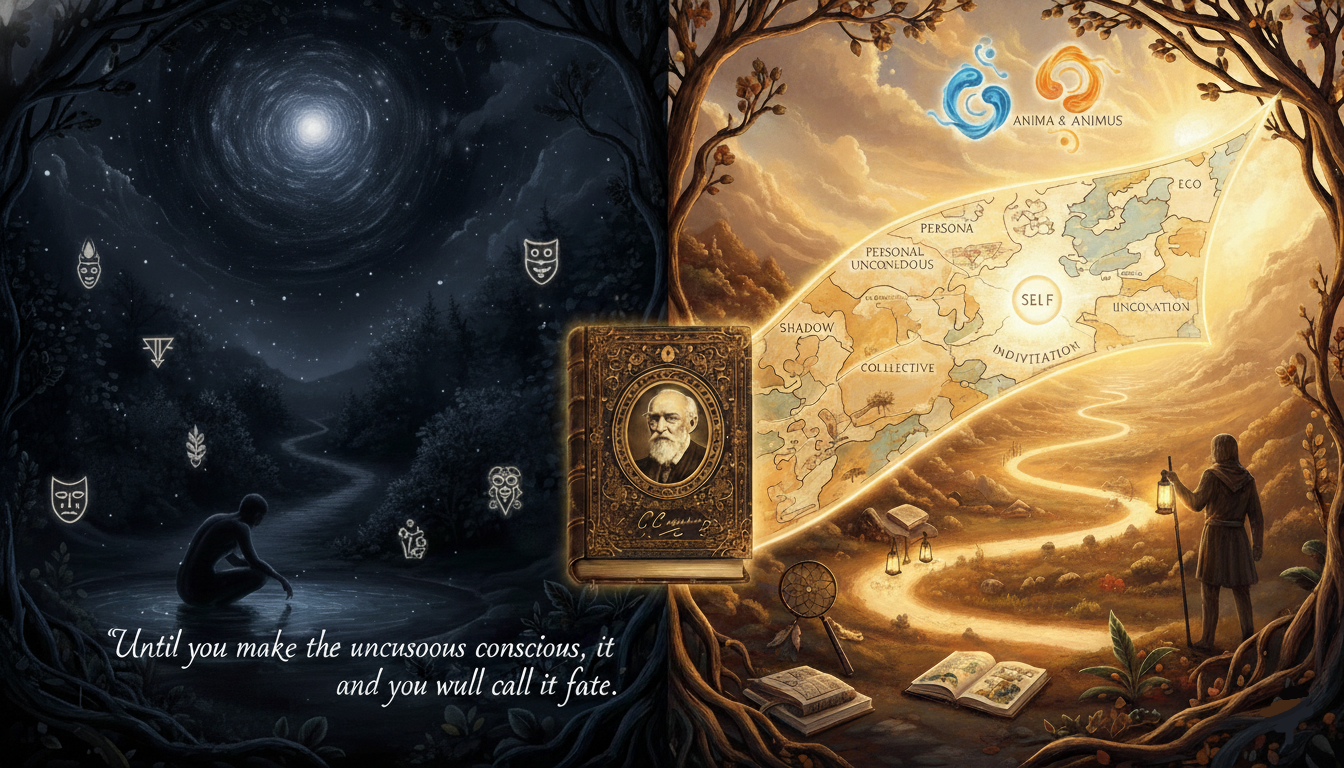
    As Jung’s ideas suggest, “Until you make the unconscious conscious, it will direct your life and you will call it fate.” (a popular paraphrase of Jung’s idea in Aion).


    The Map of Your Mind: How Jung Saw the Psyche

    Jung believed our psyche has several distinct layers, each playing a vital role in who we are.

    1. The Ego & The Persona (The “You” You Show the World)

    • The Ego: This is your conscious mind, the part of you that says “I.” It’s your center of identity, making decisions and navigating daily life.
    • The Persona: This is your social mask. It’s the polished, professional, or “nice” version of yourself you present to others. It’s a necessary tool for social harmony, but problems arise when we mistake our mask for our true self.

    2. The Shadow (The “You” You Hide)

    The Shadow is the part of your unconscious that contains all the traits you’ve disowned or repressed. This isn’t just “bad” stuff like anger or jealousy. Often, our greatest strengths—our creativity, our ambition, our wildness—are also hidden in the shadow. Jung believed that true growth comes not from ignoring the shadow, but from turning to face it.

    “One does not become enlightened by imagining figures of light, but by making the darkness conscious.” — C.G. Jung (Alchemical Studies, CW 13)

    3. The Personal & Collective Unconscious (The Deep Waters)

    • Personal Unconscious: This holds your own forgotten memories, experiences, and repressed feelings.
    • Collective Unconscious: This was one of Jung’s most groundbreaking ideas. He proposed that all of humanity shares a deep, inherited layer of the unconscious, filled with universal patterns and symbols called archetypes.

    The Archetypes: Universal Characters on Your Inner Stage

    Archetypes are the universal characters that live in the collective unconscious and show up in myths, fairy tales, and our dreams. Think of the Hero, the Wise Old Woman, the Trickster, or the Great Mother. Other powerful archetypes, like the Child (symbolizing innocence or potential) or the Shadow itself, also shape our psyche.

    These aren’t just characters in stories; they are living energies within you. Understanding which archetypes are active in your life can give you profound insight into your motivations and challenges.

    Anima & Animus (Your Inner Counterpart)

    Jung also identified two crucial archetypes that represent our inner “other.” While Jung originally described the anima as the feminine aspect in men and the animus as the masculine aspect in women, modern interpretations often see these as universal energies, like yin and yang, present in everyone. Connecting with this inner counterpart is key to wholeness.


    Individuation: The Journey to Becoming Yourself

    For Jung, the ultimate goal of life was individuation. This is the lifelong process of becoming the most whole, authentic, and complete version of yourself.

    It’s not about becoming “perfect.” It’s about integrating all the different parts of your psyche—your ego, your shadow, your anima/animus—into a balanced and functional whole, guided by a deeper center he called the Self.

    “The self is our life’s goal, for it is the completest expression of that fateful combination we call individuality.” — C.G. Jung (Two Essays on Analytical Psychology, CW 7)


    Practical Tools for Your Jungian Journey

    Jung didn’t just give us a map; he gave us tools to explore the territory.

    1. Dreamwork

    Jung saw dreams as letters from the unconscious. Instead of using a dream dictionary, he encouraged a process of amplification: connecting the images in your dream to myths, fairy tales, and your personal life to uncover their unique meaning for you.

    2. Shadow Work

    This is the courageous practice of looking at the parts of yourself you’d rather ignore. A simple way to start is to notice what you judge most harshly in others. Often, the things that irritate us most in other people are disowned parts of our own shadow.

    3. Active Imagination

    This is a powerful technique of consciously dialoguing with the figures and symbols that emerge from your unconscious through journaling, drawing, or even movement. It’s a way to build a direct relationship with your inner world.


    How to Start Today: A Simple Shadow Work Exercise

    You don’t need to be a scholar to begin working with these ideas. Try this one:

    1. Notice a Strong Reaction: Think of someone who really “pushes your buttons” or a character you strongly admire.
    2. Name the Trait: What is the specific quality in them that triggers such a strong reaction? (e.g., “They are so arrogant,” or “They are so free-spirited.”)
    3. Find the Echo: Ask yourself, gently and without judgment: “Where is a tiny echo of that trait in me? Is there a part of me that longs to be more free-spirited, or a part that I’ve suppressed for fear of being seen as arrogant?”

    This is the beginning of shadow work—reclaiming the lost and hidden parts of yourself to become more whole.


    Final Thought: Your Inner World is an Adventure

    Jung invites us on the greatest adventure of all: the exploration of our own psyche. He reminds us that our inner world is not a problem to be solved, but a rich, living landscape to be explored. By looking within, we don’t just find ourselves; we find a connection to a story that is ancient, universal, and profoundly meaningful.

    “Who looks outside, dreams; who looks inside, awakes.” — C.G. Jung (Letters, Vol. 1, 1906–1950)

  • What’s Your Life’s Purpose? How Vedic Astrology Maps the 4 Aims of Life

    What’s Your Life’s Purpose? How Vedic Astrology Maps the 4 Aims of Life

    Are you a builder, a creator, a connector, or a seeker?

    We all have these drives within us, but for each of us, one or two often take the lead. Vedic astrology (Jyotisha) has a beautiful framework for understanding these core human motivations. It’s called the Purusharthas, or the Four Aims of a Meaningful Life.

    Your birth chart isn’t just a snapshot of the sky; it’s a personal map of these four aims. It shows which drives are most natural for you, when they are likely to be activated, and how you can live a more balanced, fulfilling life by honoring them.

    Let’s explore these four aims and how you can spot them in your own chart.


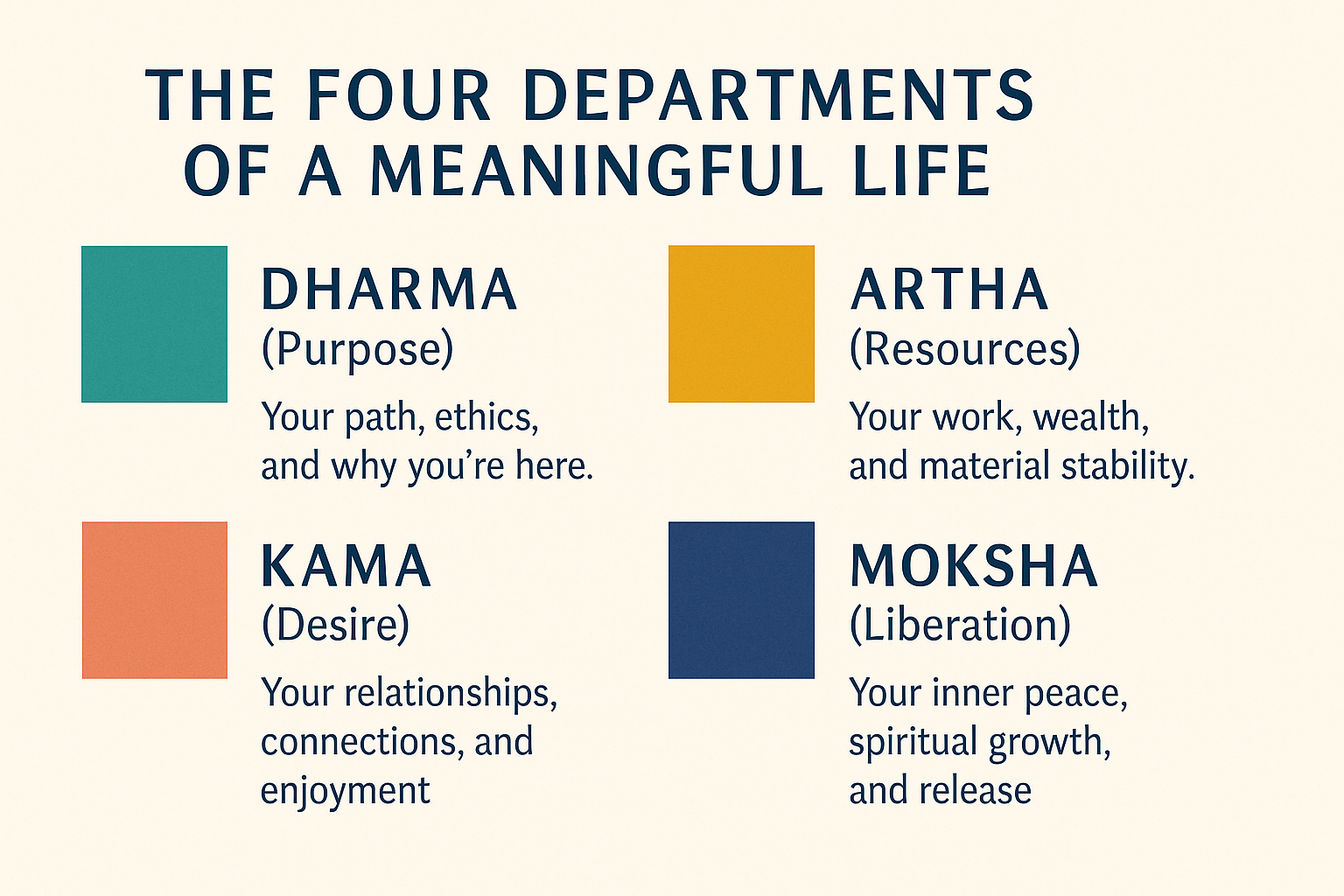
    The Four Departments of a Meaningful Life

    Think of these as the four essential departments of a complete human experience. All are necessary, but your chart will show where your energy is most concentrated.

    • Dharma (Purpose): Your path, ethics, and why you’re here.
    • Artha (Resources): Your work, wealth, and material stability.
    • Kama (Desire): Your relationships, connections, and enjoyment.
    • Moksha (Liberation): Your inner peace, spiritual growth, and release.

    Each of these aims is connected to a group of three houses in your chart.


    The Dharma Houses (1, 5, 9): Your Path & Purpose

    The core question: “Why am I here?”

    The Dharma houses are the pillars of your identity and personal mission. They represent your unique path, your creative intelligence, and the wisdom you gather along the way.

    • 1st House: Your core self, your body, and your approach to life.
    • 5th House: Your creativity, joy, intelligence, and legacy.
    • 9th House: Your beliefs, teachers, higher wisdom, and sense of meaning.

    When this area is strong in your chart, you are likely driven by a powerful sense of purpose. You thrive when you are learning, creating, teaching, and living in alignment with your personal truth.

    The Artha Houses (2, 6, 10): Your Work & Stability

    The core question: “How do I sustain myself and contribute?”

    The Artha houses are about the practical, material side of life. They govern your resources, your work, your health, and the skills you use to build a stable and secure existence.

    • 2nd House: Your wealth, values, speech, and what you consume.
    • 6th House: Your daily work, service, health routines, and problem-solving skills.
    • 10th House: Your career, reputation, and actions in the world.

    When this area is strong, you are a builder. You find fulfillment in meaningful work, providing for yourself and others, and creating tangible results in the world.

    The Kama Houses (3, 7, 11): Your Desires & Connections

    The core question: “What do I want, and who do I want to share it with?”

    The Kama houses are about your desires, ambitions, and relationships. This is the social and relational sphere of life, where you connect with others to achieve shared goals and find enjoyment.

    • 3rd House: Your courage, curiosity, personal initiative, and skills.
    • 7th House: Your romantic partnerships, business contracts, and one-on-one relationships.
    • 11th House: Your friendships, networks, community, and long-term aspirations.

    When this area is strong, you are a connector. You come alive through collaboration, social interaction, and pursuing your ambitions with the help of your allies.

    The Moksha Houses (4, 8, 12): Your Inner Freedom

    The core question: “What will set me free?”

    The Moksha houses represent the inner, psychological, and spiritual dimensions of life. This is where you heal, transform, and find true contentment by letting go of attachments and understanding your deeper self.

    • 4th House: Your emotional foundation, home, mother, and inner peace.
    • 8th House: Your deepest transformations, healing, psychology, and hidden knowledge.
    • 12th House: Your spiritual practices, retreat, dreams, and final liberation.

    When this area is strong, you are a seeker. Your path is internal, focused on emotional maturity, healing, and connecting with a reality beyond the material world.


    A Quick Note on “Karma”

    You might be wondering where “karma” fits in. Karma means action, and it runs through your entire chart. Every choice you make in every house is a karma. The 10th House has a special title, the Karma Bhava, because it represents your most visible actions in the world—your career and public life.


    How to Read This in Your Chart: A Simple 3-Step Process

    1. Find Your Focus: Look at your chart and do a quick count. Which group of houses (Dharma, Artha, Kama, or Moksha) holds the most planets? This reveals your natural, lifelong emphasis.
    2. Look at the Timing: Your focus isn’t static. In Vedic astrology, Dashas are planetary periods that act like “life chapters.” When the Dasha of a planet connected to your Artha houses begins, your career and finances will naturally take center stage.
    3. Aim for Balance, Not Perfection: The goal isn’t to be 100% focused on all four aims at once. It’s about recognizing which “department” needs your attention now and honoring it, without completely neglecting the others.

    Your 5-Minute Chart Check-In

    Ready to try it? Grab your chart.

    1. Circle the planets in your Dharma houses (1, 5, 9).
    2. Box the planets in your Artha houses (2, 6, 10).
    3. Underline the planets in your Kama houses (3, 7, 11).
    4. Star the planets in your Moksha houses (4, 8, 12).

    Which group stands out the most? What does that tell you about your core nature?

    Now, pick one micro-action you can take today to honor each aim:

    • Dharma: Read an inspiring article or share something you know.
    • Artha: Complete one practical task on your to-do list.
    • Kama: Send a thoughtful message to a friend or collaborator.
    • Moksha: Spend 5 minutes journaling or sitting in silence.

    Final Thought: Your Chart is a Map of Priorities

    Your birth chart doesn’t lock you into a single destiny—it gives you a map of your soul’s priorities. By understanding whether you’re in a season of Dharma, Artha, Kama, or Moksha, you can stop fighting the cosmic current and start flowing with it.

    When you align your daily actions with the deeper themes of your life, you find more meaning, less resistance, and a powerful sense of coming home to yourself.