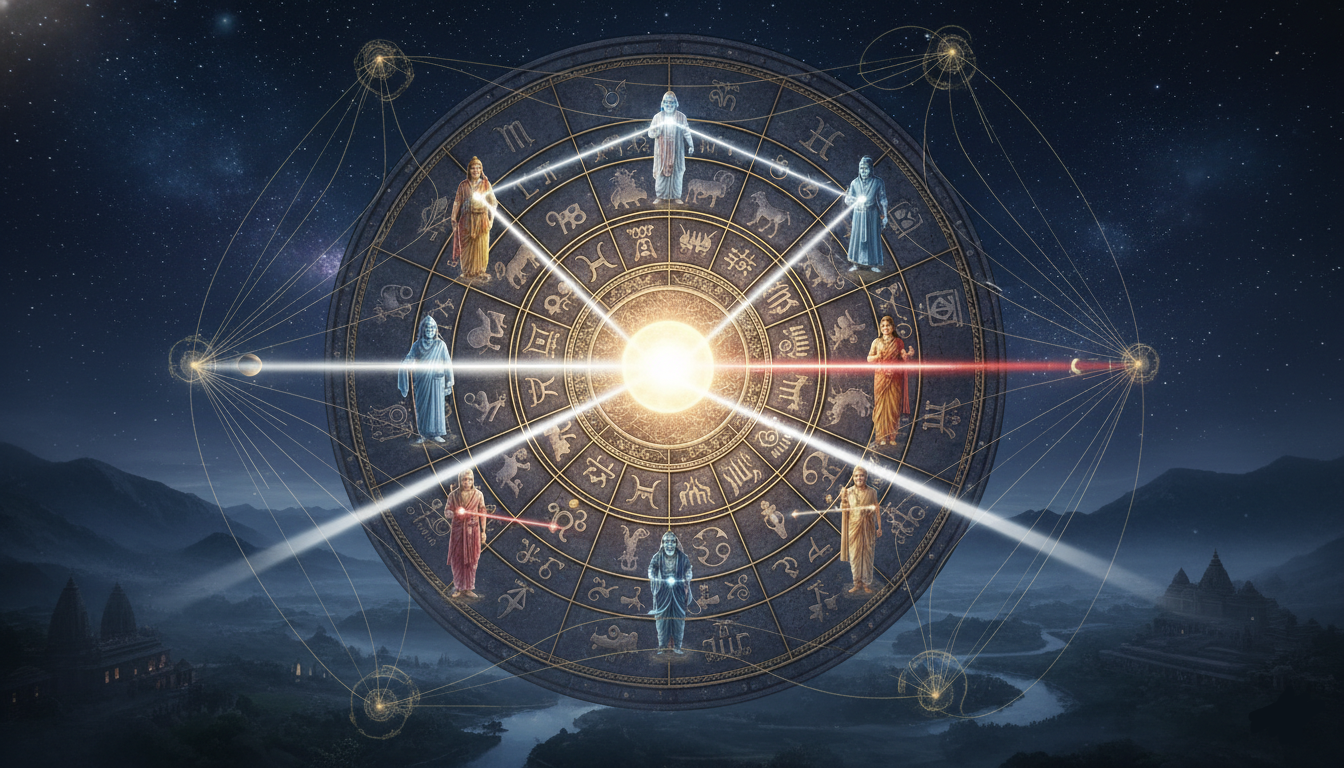
In Vedic astrology, planets don’t just sit quietly in their signs. They are active forces that look at, influence, and interact with other parts of your chart. This “gaze” is called an aspect, or Drishti.
Understanding aspects is like unlocking a new dimension in your birth chart. It shows you the hidden lines of force, revealing which areas of your life are in constant conversation, where you feel pressure, and where you receive support.
Vedic astrology uses two brilliant and distinct systems of aspects. Think of them as two different kinds of influence: a direct, personal gaze and a broader, environmental network. Let’s explore both.
1. Planetary Aspects (Graha Drishti): The Direct Gaze
This is the most common type of aspect. It’s the direct, focused line of sight that a planet projects from its own position. Imagine a person in a room—they can look directly at others, sending a clear and potent signal.
A key concept here: this “gaze” covers the entire sign or house it lands in. It’s not limited to an exact degree, which is a key difference from some other astrological systems.
The rules are simple and elegant:
A) The Universal Aspect:
- All planets cast a full aspect on the 7th house/sign from where they are sitting. This is the energy of direct relationship, opposition, and partnership.
B) The Special Aspects:
Three planets have “special forces” and can cast additional full aspects, giving them a much wider reach and influence in your chart.
- 🪐 Saturn (The Taskmaster): In addition to the 7th, Saturn also aspects the 3rd and 10th houses from its position. Its gaze brings themes of discipline, responsibility, hard work, and reality checks to those areas.
- 🧠 Mars (The Warrior): In addition to the 7th, Mars also aspects the 4th and 8th houses. Its gaze brings energy, action, challenge, and the drive to protect or investigate.
- ✨ Jupiter (The Guru): In addition to the 7th, Jupiter also aspects the 5th and 9th houses. Its gaze brings wisdom, opportunity, grace, and expansion.
A Note for Western Astrology Students: If you’re used to working with “orbs” (where an aspect is only active within a few degrees), you can set that idea aside here. In Vedic astrology, if a planet aspects a sign, it influences the entire 30-degree sign and any planets within it, regardless of their specific degree.
How to Use It: Planetary aspects show you where a planet is applying direct psychological pressure or support. The house receiving the aspect will be strongly influenced by the nature of the planet looking at it.
2. Sign Aspects (Rashi Drishti): The Environmental Network
This is a different and fascinating layer of influence. Instead of coming from the planet, this aspect comes from the sign itself. Think of it not as a person’s gaze, but as the architecture of the room—certain signs are built with windows that look out onto other specific signs.
Any planet located in a sign gets to use that sign’s “windows” to see and influence others. The rules are based on the sign’s modality:
- Movable Signs (Aries, Cancer, Libra, Capricorn): These are the initiators. They aspect all Fixed signs (Taurus, Leo, Scorpio, Aquarius), except for the one right next door.
- Fixed Signs (Taurus, Leo, Scorpio, Aquarius): These are the sustainers. They aspect all Movable signs (Aries, Cancer, Libra, Capricorn), except for the one right next door.
- Dual Signs (Gemini, Virgo, Sagittarius, Pisces): These are the adapters. They aspect all other Dual signs.
How to Use It: Sign aspects reveal the broader networks and structural relationships in your chart. They show how different life themes (represented by the signs) are fundamentally linked, creating a narrative that planets within them participate in.
Let’s See It in Action: A Simple Example
Imagine you have Saturn in Capricorn in your chart.
- Planetary Aspects (The Direct Gaze):
- Saturn looks across to the 7th sign (Cancer).
- It also casts its special aspects on the 3rd sign (Pisces) and the 10th sign (Libra).
- The Story: Saturn is applying direct pressure, discipline, and structure to the life areas represented by Cancer, Pisces, and Libra.
- Sign Aspects (The Environmental Network):
- Capricorn is a Movable sign. It aspects all Fixed signs (Taurus, Leo, Scorpio), skipping its neighbor Aquarius.
- The Story: The themes of Capricorn (hard work, ambition) are structurally linked to the themes of Taurus (resources), Leo (authority), and Scorpio (transformation). Your Saturn in Capricorn is part of this larger network of stability and power.
By reading both, you get a 3D picture: Saturn is applying direct, focused pressure on certain areas, and it’s doing so from within a broader network that connects it to other key themes in your life.
Quick Cheat Sheet
Bookmark this for easy reference!
| Aspect Type | What It Shows | Key Rules |
| Planetary Aspects | The planet’s personal will and direct focus. | All planets see the 7th. Mars adds 4/8. Jupiter adds 5/9. Saturn adds 3/10. |
| Sign Aspects | The sign’s built-in network and environmental connections. | Movable ↔ Fixed (skipping neighbors). Dual ↔ Dual. |
Final Thought: Two Lenses for a Richer View
Planetary aspects and sign aspects aren’t competing systems; they are two complementary lenses that give you a richer, more nuanced understanding of your chart.
- Planetary aspects show you the psychological force—what a planet actively wants to influence.
- Sign aspects show you the structural field—the environment and networks that a planet works within.
By learning to see both, you move from a flat, 2D map of your life to a dynamic, interconnected, 3D world.
Leave a Reply