Author: cuonghv

  • How to Read a Vedic Astrology Chart (North Indian Style): A Beginner’s Guide

    How to Read a Vedic Astrology Chart (North Indian Style): A Beginner’s Guide

    So, you’ve generated your first Vedic astrology chart, and now you’re staring at a dazzling diamond of lines, numbers, and cryptic symbols. It looks fascinating, but also… a little intimidating. Where do you even begin?

    Don’t worry. The North Indian chart style might look complex, but it follows a few simple, consistent rules. Once you learn them, you’ll be able to navigate any chart with confidence.

    In this guide, we’ll walk you through it step-by-step. In less than 10 minutes, you’ll understand the basic anatomy and logic of your own personal cosmic map.


    The Two Golden Rules of the North Indian Chart

    Before we go anywhere, let’s learn the two “golden rules.” If you remember these, you’ll never get lost.

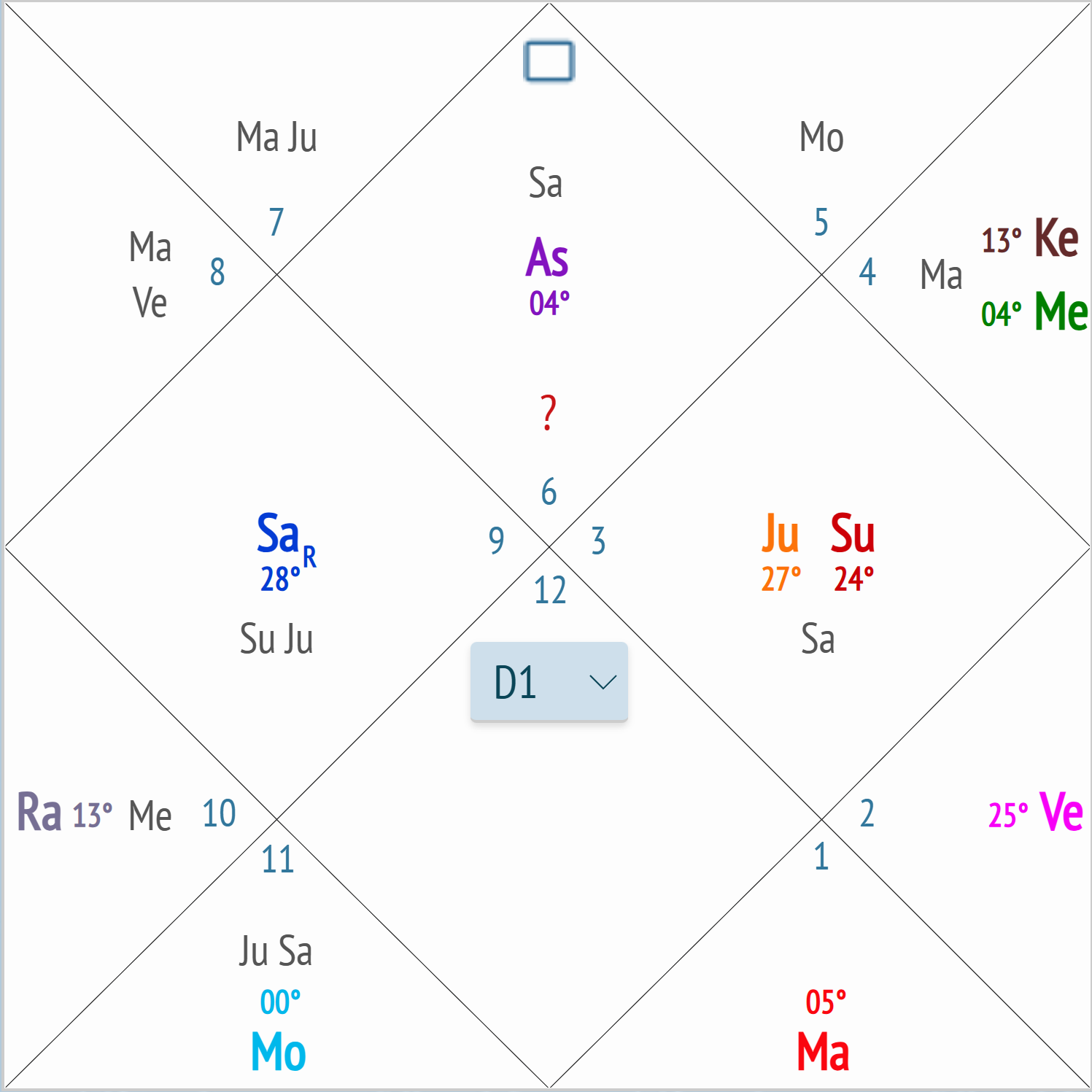
    Rule #1: The Houses Are Fixed. Think of the chart as a building with 12 rooms. The rooms (the houses) never, ever move. The First House is always at the top, the Second House is always to its left, and so on.

    Rule #2: The Signs Rotate. While the rooms are fixed, the decorations inside them (the zodiac signs) change for every person. The numbers you see printed in the boxes tell you which sign falls into which fixed room in your unique chart.

    That’s it! Houses are fixed places; signs are the energies that occupy those places.


    Step 1: Find Your Starting Point (The Ascendant)

    Everything in your chart begins with the Ascendant, also known as the Lagna. This is your personal horizon at the moment of your birth, and it represents you—your body, your personality, and your approach to life.

    In a North Indian chart, the Ascendant is always the top-center diamond. This box is your First House.


    Step 2: Count the Houses (Always Counter-Clockwise!)

    From the First House at the top, the other houses follow in a simple, predictable order: counter-clockwise.

    The box to the left of the Lagna is the 2nd House, the next one is the 3rd, and so on, all the way around to the 12th House, which is the box to the right of the Lagna.

    This order never changes. Memorize this flow, and you’ll instantly know which area of life each box represents.


    Step 3: Decode the Numbers (These Are Signs, Not Houses!)

    This is the most common stumbling block for beginners, so let’s make it crystal clear. The small numbers printed inside the boxes are not house numbers. They are ZODIAC SIGN numbers.

    Since the houses are fixed, these numbers tell you which sign occupies which house.

    • 1 = Aries
    • 2 = Taurus
    • 3 = Gemini
    • 4 = Cancer
    • 5 = Leo
    • 6 = Virgo
    • 7 = Libra
    • 8 = Scorpio
    • 9 = Sagittarius
    • 10 = Capricorn
    • 11 = Aquarius
    • 12 = Pisces

    So, if you see a “5” in the top-center diamond, it means you have a Leo Ascendant (Leo is in your First House). If you see a “10” in the box on the far left, it means you have Capricorn in your Fourth House.


    Step 4: Put It All Together (Planet in Sign in House)

    Now for the fun part! You’ll see little abbreviations for planets (like Su for Sun, Mo for Moon, Sa for Saturn) placed in the boxes. This is where you start to read your story.

    The basic formula is:
    Planet’s Energy + Sign’s Style + House’s Topic = Your Unique Experience

    Let’s try an example. Imagine you see Ve (Venus) in the box on the far right of the chart (the 10th House), and that box contains the sign number 7 (Libra).

    • Planet: Venus (love, harmony, beauty, relationships)
    • Sign’s Style: In Libra (diplomatic, balanced, artistic, social)
    • House’s Topic: In the 10th House (career, public status, actions in the world)

    The Reading: Your career and public life (10th House) are best expressed through diplomacy, partnerships, and creativity (Venus in Libra). You might thrive in a field related to art, design, law, or counseling.


    A Quick Note: North vs. South Indian Charts

    If you explore Jyotisha, you’ll also see a square-shaped South Indian chart. Don’t get confused! They show the exact same information, just with a different layout.

    • North Indian (this guide): Houses are fixed, signs rotate.
    • South Indian: Signs are fixed, houses rotate.

    It’s like having two different map styles for the same city. Most people find one style clicks better for them.


    Start Exploring Your Chart

    You now have the fundamental rules to navigate your North Indian chart. It’s no longer an intimidating puzzle; it’s a map waiting to be explored.

    1. Find your Lagna (Ascendant) in the top diamond. What sign number is there?
    2. Count counter-clockwise to find your 7th House (relationships) and 10th House (career). What signs are in them?
    3. Look for where the Moon (Mo) is placed. The house, sign, and any other planets there will tell you a rich story about your inner world.

    Welcome to the start of a fascinating journey. Be patient, be curious, and let the science of light illuminate your path.
  • Why Your Zodiac Sign Might Be Different in Vedic Astrology

    Why Your Zodiac Sign Might Be Different in Vedic Astrology

    You’ve known your whole life that you’re a Leo. It’s on your favorite coffee mug, you read the horoscopes, and you’ve always vibed with that fiery, main-stage energy.

    But what if you pulled up a Vedic astrology chart and it told you that you’re actually a… Cancer?

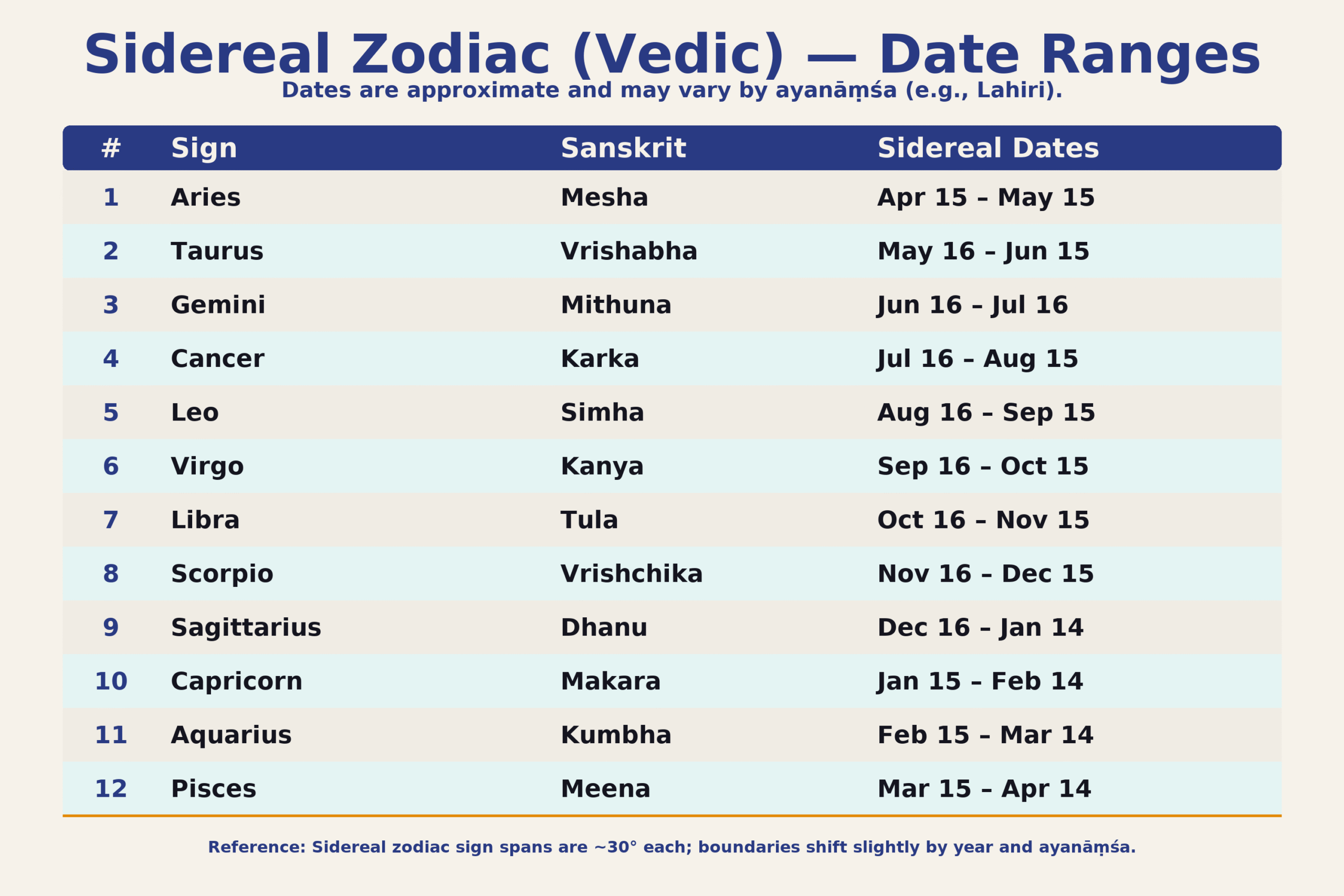
    Before you have an identity crisis, let’s clear things up. Your sign didn’t really change—you just looked at the sky through a different window. That window is the Sidereal Zodiac, the foundation of Vedic astrology, and it offers a powerful new perspective on who you are.

    Let’s break down the difference between the two zodiacs and why it matters.


    The Two Zodiacs: A Tale of Two Starting Points

    At its core, the difference is simple. Both systems map the same sky, but they start counting from a different “zero point.”

    The Tropical Zodiac (Used in Western Astrology)

    Think of this as the Seasonal Zodiac. Its starting point (0° Aries) is locked to the Spring Equinox in the Northern Hemisphere. It’s a beautiful system that reflects the Earth’s relationship with the Sun and the changing of the seasons.

    The Sidereal Zodiac (Used in Vedic Astrology)

    Think of this as the Star Zodiac. Its starting point is anchored to the actual, visible constellations in the night sky. It’s a map of where the planets are in relation to the stars themselves.

    The Easiest Analogy:The Tropical Zodiac is like a calendar, marking time by the seasons.The Sidereal Zodiac is like a star map, marking location by the constellations.


    So, Why Are They 24 Degrees Apart?

    Here’s the cosmic twist: the Earth has a slow wobble, like a spinning top losing steam. This is called precession.

    Over thousands of years, this wobble causes the Spring Equinox to drift backward against the backdrop of the stars.

    • The Tropical Zodiac moves with the equinox, so 0° Aries is always the first day of spring.
    • The Sidereal Zodiac stays with the stars, ignoring the seasonal shift.

    Today, this slow drift has created a gap of about 24 degrees between the two systems. This gap is called the ayanamsa.


    Okay, But What Does This Mean for Me?

    That 24-degree difference is a big deal. Since each zodiac sign is 30 degrees wide, this gap is enough to shift many of your planetary placements—including your “Big Three”—into the previous sign.

    1. Your Core Identity Might Get a New Flavor

    Your Sun Sign (your core self), Moon Sign (your emotional world), and Ascendant/Rising Sign (how you meet the world) could all change. That Leo Sun might become a Cancer Sun in your Sidereal chart. This doesn’t mean your Western chart was “wrong.” It simply means the Sidereal lens might highlight your more nurturing, sensitive, and private Cancerian qualities. Many people find that the Sidereal placement reveals a deeper, more private layer of themselves.

    2. The Strength of Your Planets Changes

    In Vedic astrology, a planet’s strength is heavily influenced by the sign it’s in. A planet that feels powerful and at home in one sign might feel challenged in another. This shift can offer a whole new understanding of your natural strengths and where you face your biggest lessons.

    3. The Focus of Your Life Shifts

    Your Ascendant (or Rising Sign) sets the stage for your entire life, marking the First House. If your Ascendant shifts from Libra to Virgo, the focus of every area of your life (career, relationships, family) gets a new spin.


    So, Which Zodiac Is “Right”?

    This is the most important question, and the answer is: both are right.

    They are two different, internally consistent systems designed to do different things. The better question is: Which tool do you need right now?

    • If you love exploring personality through the lens of seasons and psychological archetypes, the Tropical Zodiac is a brilliant tool.
    • If you want to explore the ancient Vedic techniques of timing, karma, and remedies that are tied to the constellations (like the Nakshatras), the Sidereal Zodiac is the way to go.

    Many modern astrologers use both! At Psyveda, we focus on the Sidereal system because it’s the foundation for all the predictive and remedial tools within Jyotisha.


    How to Find Your Sidereal Chart in 60 Seconds

    Curious to see your chart? It’s easy.

    1. Grab your birth info: You’ll need your exact date, time, and place of birth.
    2. Use an online calculator: Search for a “Vedic Astrology Chart Calculator.”
    3. Select the right settings: Make sure the zodiac is set to “Sidereal” and the ayanamsa is “Lahiri” (it’s the most common).
    4. Find your Big Three: Look for your Lagna (Ascendant), your Moon Sign, and your Moon Nakshatra. These are the cornerstones of a Vedic reading.

    Now, compare it to your Western chart. What feels different? What feels surprisingly familiar?


    Common Questions, Clear Answers

    “Was my Western chart wrong this whole time?”
    Not at all! You just looked at the sky through a different lens. It’s like describing a location with a street address versus GPS coordinates. Both lead to the same place, but they use a different reference system.

    “What’s this about a 13th sign, Ophiuchus?”
    Both the Tropical and Sidereal zodiacs are systems that divide the sky into 12 equal 30-degree signs. Ophiuchus is a constellation that the Sun passes through, but it is not one of the 12 signs in either astrological system.

    “Which ayanamsa should I use?”
    Lahiri is the most common and a great place to start. If you begin working with a specific teacher, they may use another one. The key is to pick one and stay consistent.


    Final Thought: A New Layer of You

    Exploring your Sidereal chart isn’t about erasing what you know about yourself—it’s about adding a new, profound layer to your self-awareness. It connects you to the ancient tradition of watching the stars and offers a practical, time-tested way to navigate the seasons of your life.

    Why not give it a look? You might just discover a part of yourself you always knew was there, but never had a name for.

  • What Is Vedic Astrology? A Beginner’s Guide to the ‘Science of Light’

    What Is Vedic Astrology? A Beginner’s Guide to the ‘Science of Light’

    Have you ever felt that there’s a deeper rhythm to your life? A cosmic clock ticking behind the scenes? Welcome to Jyotisha, the traditional astrology of India.

    Its name translates to the ‘science of light.’ It uses the light of the planets and stars not just to understand your personality, but to illuminate the unique path and timing of your life’s journey.

    Think of your birth chart as your personal cosmic blueprint. Jyotisha provides the tools to read that blueprint, helping you understand your strengths, navigate challenges, and act when the timing is right. It’s a practical system for living a more conscious and aligned life.


    The #1 thing to know first: A different zodiac

    Before we dive in, there’s one key difference between Jyotisha and most Western astrology: the zodiac they use.

    • Jyotisha uses the Sidereal Zodiac. This zodiac is “fixed” to the stars and aligns with the actual constellations in the sky.
    • Western Astrology uses the Tropical Zodiac. This zodiac is “seasonal” and is fixed to the start of spring in the Northern Hemisphere.

    Because of precession, the two zodiacs are currently ~24° apart (using the common Lahiri ayanamsa). The exact offset varies slightly by ayanamsa and increases slowly over time. This means your Sun, Moon, or Ascendant sign may be in the previous sign in your Jyotisha chart. If you’ve always been a Libra, you might be a Virgo here. And that’s okay! It’s simply a different, equally valid frame of reference.


    The Four Core Pillars of Your Jyotisha Chart

    Your chart is built from four key components that work together to tell your story.

    1. The Grahas (The 9 Celestial Bodies)

    In Jyotisha, the main players are called Grahas (“seizers” or celestial influencers). They represent core energies and drives within you. This group includes the Sun, the Moon, and the lunar nodes Rahu and Ketu—they’re not limited to just astronomical planets.

    • Sun: Your soul, ego, and vitality.
    • Moon: Your mind, emotions, and inner peace.
    • Mars: Your energy, action, and courage.
    • Mercury: Your intellect, communication, and curiosity.
    • Jupiter: Your wisdom, luck, and expansion.
    • Venus: Your love, creativity, and pleasure.
    • Saturn: Your discipline, responsibility, and reality.
    • Rahu (desire, amplification) & Ketu (release, insight): The karmic axis.

    2. The Rasis (The 12 Zodiac Signs)

    These are the 12 backdrops of the zodiac. If the Grahas are the actors, the Rasis are the roles they play or the costumes they wear. Each sign gives the Graha within it a unique quality and style of expression.

    • Mesha (Aries): Action, pioneering, impulsive.
    • Vrishabha (Taurus): Stability, sensual, grounded.
    • Mithuna (Gemini): Curious, communicative, playful.
    • Karka (Cancer): Nurturing, emotional, protective.
    • Simha (Leo): Regal, creative, leadership.
    • Kanya (Virgo): Analytical, detailed, service-oriented.
    • Tula (Libra): Harmony, partnership, diplomatic.
    • Vrishchika (Scorpio): Intense, transformative, deep.
    • Dhanu (Sagittarius): Optimistic, philosophical, adventurous.
    • Makara (Capricorn): Ambitious, structured, disciplined.
    • Kumbha (Aquarius): Innovative, humanitarian, unconventional.
    • Mina (Pisces): Intuitive, compassionate, spiritual.

    3. The Bhavas (The 12 Houses)

    If the Grahas are actors playing roles (Rasis), the Bhavas are the stages where the action happens. Houses are read from the Lagna (Ascendant); the 1st house starts at the Lagna, and the rest follow in zodiacal order.

    • 1st: Self, body, vitality, approach to life
    • 2nd: Wealth, speech, values, food, family
    • 3rd: Effort, siblings, skills, courage
    • 4th: Home, mother, property, inner security
    • 5th: Children, creativity, intelligence, romance
    • 6th: Health, debts, service, obstacles (and overcoming them)
    • 7th: Relationships, spouse, contracts, public dealings
    • 8th: Transformation, longevity, shared resources, the hidden
    • 9th: Dharma, teachers, higher learning, fortune
    • 10th: Career, status, actions in the world
    • 11th: Gains, networks, aspirations
    • 12th: Loss, expenditure, liberation, foreign places, sleep

    4. The Nakshatras (The 27 Lunar Mansions)

    This is the secret spice of Jyotisha. The zodiac is further divided into 27 constellations called Nakshatras. The Nakshatra your Moon was in at birth provides a deep, nuanced look into your emotional nature and life path. (Jyotisha primarily uses 27 nakshatras, though some traditions acknowledge a 28th, Abhijit, for specific uses.)


    Your Personal North Star: The Lagna (Ascendant)

    The single most important point in your chart is the Lagna. This is the zodiacal sign that was rising on the eastern horizon at your birth. The Lagna is the lens through which you experience your entire life, representing your physical body and core temperament.


    The Magic of Timing: How Jyotisha Predicts

    This is where Jyotisha truly shines. It uses a sophisticated system to map out the “seasons” of your life.

    Dashas (Your Life Chapters)

    The Vimshottari Dasha system divides your life into planetary periods (e.g., a 20-year Venus Dasha, a 6-year Sun Dasha). The planet ruling your current “chapter” sets the main theme.

    Transits

    Transits are the current, real-time movements of the Grahas. When a transiting Graha passes over a key point in your chart, it activates it.

    Rule of Thumb: The dasha indicates what is possible in a life chapter; transits time when those promised themes ripen.


    What Can Jyotisha Help You With?

    • Timing: When is the best time to change careers, move, or get married?
    • Strategy: What career path aligns with my natural talents?
    • Self-Knowledge: What are my hidden strengths and karmic lessons?
    • Remedies: Remedies (like charity, mantra, disciplined routines) are meant to support wise action, not replace it.

    Common Myths, Debunked

    • Myth: “Bad” planets (like Saturn) mean a bad life.
      • Reality: These Grahas build strength and discipline. They are challenging, but they forge your greatest successes.
    • Myth: It’s all fatalistic.
      • Reality: Your chart shows the landscape and the weather, but you have free will to choose how you navigate it. Jyotisha is about empowerment.

    How to Get Started

    1. Find Your Accurate Birth Info: You need your exact date, location, and, most importantly, time of birth.
    2. Generate Your Chart: When generating your chart, select Sidereal (Lahiri ayanamsa). Other ayanamsas (e.g., Krishnamurti, Raman) exist; pick one and stay consistent.
    3. Identify the Basics: Find your Lagna, your Moon Sign (Chandra Rasi), and your Moon Nakshatra.
    4. Check Your Current Dasha: Find out which planetary “chapter” you’re in. This tells you the main theme of your life right now.

    Frequently Asked Questions

    Q: Will my signs really change from my Western chart?
    A: Very likely, yes. Because Jyotisha uses the Sidereal zodiac, your Sun, Moon, and Ascendant signs may shift back into the previous sign. It’s a new perspective to explore!

    Q: What if I don’t know my exact birth time?
    A: An accurate birth time is crucial. If you’re unsure, a professional Jyotisha astrologer can perform a “chart rectification” to help determine the correct time.

    Q: Is Jyotisha hard to learn?
    A: It’s deep, but you can learn the basics quickly. Start with your Ascendant, your Moon, and your current Dasha lord. Mastering these will give you 80% of the core story.