Category: Vedic

  • The Two Ways Planets See: A Beginner’s Guide to Aspects in Vedic Astrology

    The Two Ways Planets See: A Beginner’s Guide to Aspects in Vedic Astrology

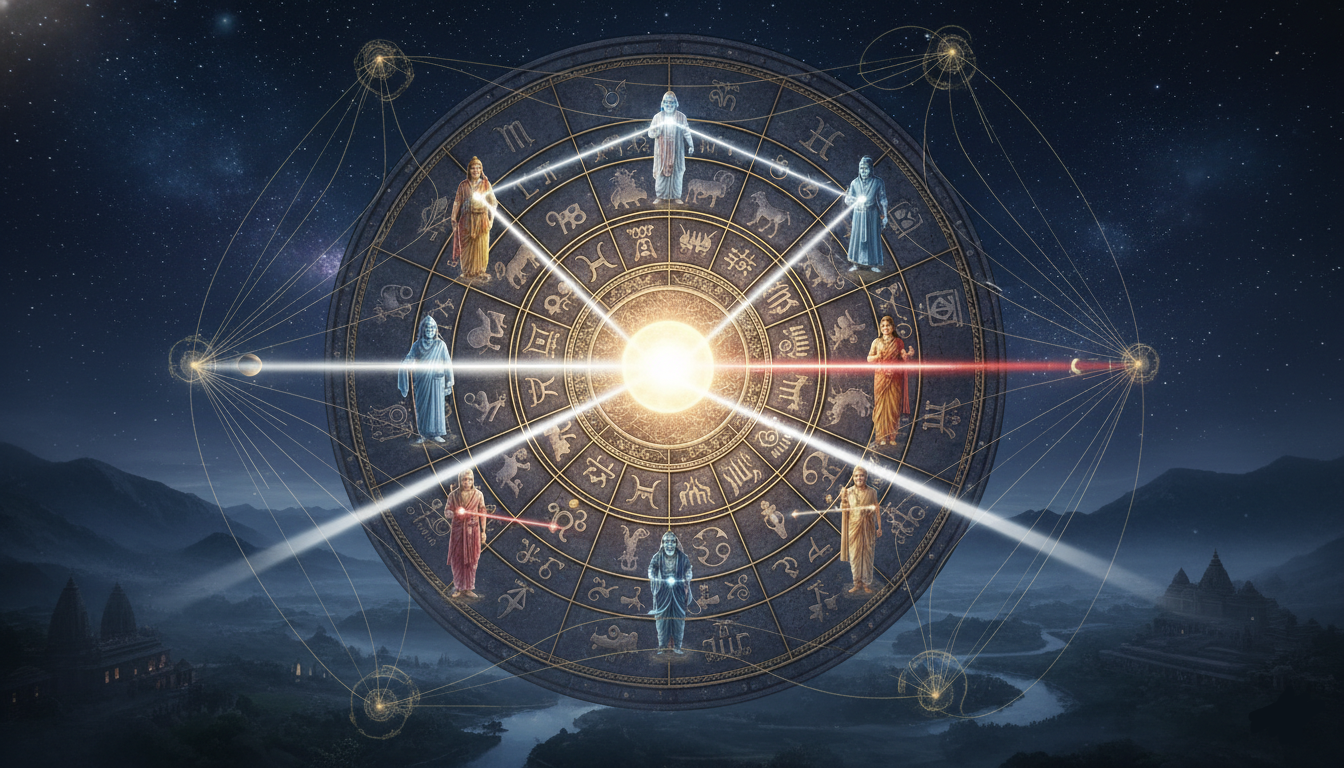
    In Vedic astrology, planets don’t just sit quietly in their signs. They are active forces that look at, influence, and interact with other parts of your chart. This “gaze” is called an aspect, or Drishti.

    Understanding aspects is like unlocking a new dimension in your birth chart. It shows you the hidden lines of force, revealing which areas of your life are in constant conversation, where you feel pressure, and where you receive support.

    Vedic astrology uses two brilliant and distinct systems of aspects. Think of them as two different kinds of influence: a direct, personal gaze and a broader, environmental network. Let’s explore both.


    1. Planetary Aspects (Graha Drishti): The Direct Gaze

    This is the most common type of aspect. It’s the direct, focused line of sight that a planet projects from its own position. Imagine a person in a room—they can look directly at others, sending a clear and potent signal.

    A key concept here: this “gaze” covers the entire sign or house it lands in. It’s not limited to an exact degree, which is a key difference from some other astrological systems.

    The rules are simple and elegant:

    A) The Universal Aspect:

    • All planets cast a full aspect on the 7th house/sign from where they are sitting. This is the energy of direct relationship, opposition, and partnership.

    B) The Special Aspects:
    Three planets have “special forces” and can cast additional full aspects, giving them a much wider reach and influence in your chart.

    • 🪐 Saturn (The Taskmaster): In addition to the 7th, Saturn also aspects the 3rd and 10th houses from its position. Its gaze brings themes of discipline, responsibility, hard work, and reality checks to those areas.
    • 🧠 Mars (The Warrior): In addition to the 7th, Mars also aspects the 4th and 8th houses. Its gaze brings energy, action, challenge, and the drive to protect or investigate.
    • Jupiter (The Guru): In addition to the 7th, Jupiter also aspects the 5th and 9th houses. Its gaze brings wisdom, opportunity, grace, and expansion.

    A Note for Western Astrology Students: If you’re used to working with “orbs” (where an aspect is only active within a few degrees), you can set that idea aside here. In Vedic astrology, if a planet aspects a sign, it influences the entire 30-degree sign and any planets within it, regardless of their specific degree.

    How to Use It: Planetary aspects show you where a planet is applying direct psychological pressure or support. The house receiving the aspect will be strongly influenced by the nature of the planet looking at it.


    2. Sign Aspects (Rashi Drishti): The Environmental Network

    This is a different and fascinating layer of influence. Instead of coming from the planet, this aspect comes from the sign itself. Think of it not as a person’s gaze, but as the architecture of the room—certain signs are built with windows that look out onto other specific signs.

    Any planet located in a sign gets to use that sign’s “windows” to see and influence others. The rules are based on the sign’s modality:

    • Movable Signs (Aries, Cancer, Libra, Capricorn): These are the initiators. They aspect all Fixed signs (Taurus, Leo, Scorpio, Aquarius), except for the one right next door.
    • Fixed Signs (Taurus, Leo, Scorpio, Aquarius): These are the sustainers. They aspect all Movable signs (Aries, Cancer, Libra, Capricorn), except for the one right next door.
    • Dual Signs (Gemini, Virgo, Sagittarius, Pisces): These are the adapters. They aspect all other Dual signs.

    How to Use It: Sign aspects reveal the broader networks and structural relationships in your chart. They show how different life themes (represented by the signs) are fundamentally linked, creating a narrative that planets within them participate in.


    Let’s See It in Action: A Simple Example

    Imagine you have Saturn in Capricorn in your chart.

    1. Planetary Aspects (The Direct Gaze):
      • Saturn looks across to the 7th sign (Cancer).
      • It also casts its special aspects on the 3rd sign (Pisces) and the 10th sign (Libra).
      • The Story: Saturn is applying direct pressure, discipline, and structure to the life areas represented by Cancer, Pisces, and Libra.
    2. Sign Aspects (The Environmental Network):
      • Capricorn is a Movable sign. It aspects all Fixed signs (Taurus, Leo, Scorpio), skipping its neighbor Aquarius.
      • The Story: The themes of Capricorn (hard work, ambition) are structurally linked to the themes of Taurus (resources), Leo (authority), and Scorpio (transformation). Your Saturn in Capricorn is part of this larger network of stability and power.

    By reading both, you get a 3D picture: Saturn is applying direct, focused pressure on certain areas, and it’s doing so from within a broader network that connects it to other key themes in your life.


    Quick Cheat Sheet

    Bookmark this for easy reference!

    Aspect TypeWhat It ShowsKey Rules
    Planetary AspectsThe planet’s personal will and direct focus.All planets see the 7th. Mars adds 4/8. Jupiter adds 5/9. Saturn adds 3/10.
    Sign AspectsThe sign’s built-in network and environmental connections.Movable ↔ Fixed (skipping neighbors). Dual ↔ Dual.

    Final Thought: Two Lenses for a Richer View

    Planetary aspects and sign aspects aren’t competing systems; they are two complementary lenses that give you a richer, more nuanced understanding of your chart.

    • Planetary aspects show you the psychological force—what a planet actively wants to influence.
    • Sign aspects show you the structural field—the environment and networks that a planet works within.

    By learning to see both, you move from a flat, 2D map of your life to a dynamic, interconnected, 3D world.
  • The 5 Elements of a Vedic Day: Your Guide to the Panchanga

    The 5 Elements of a Vedic Day: Your Guide to the Panchanga

    Ever have one of those days where you feel totally in flow? The meeting you scheduled goes perfectly, your creative ideas land, and you get more done in a few hours than you did all last week. Then there are other days where every task feels like a struggle.

    What if there was a way to understand the unique energy of each day before it even begins?

    In Vedic tradition, there is. It’s called the Panchanga.

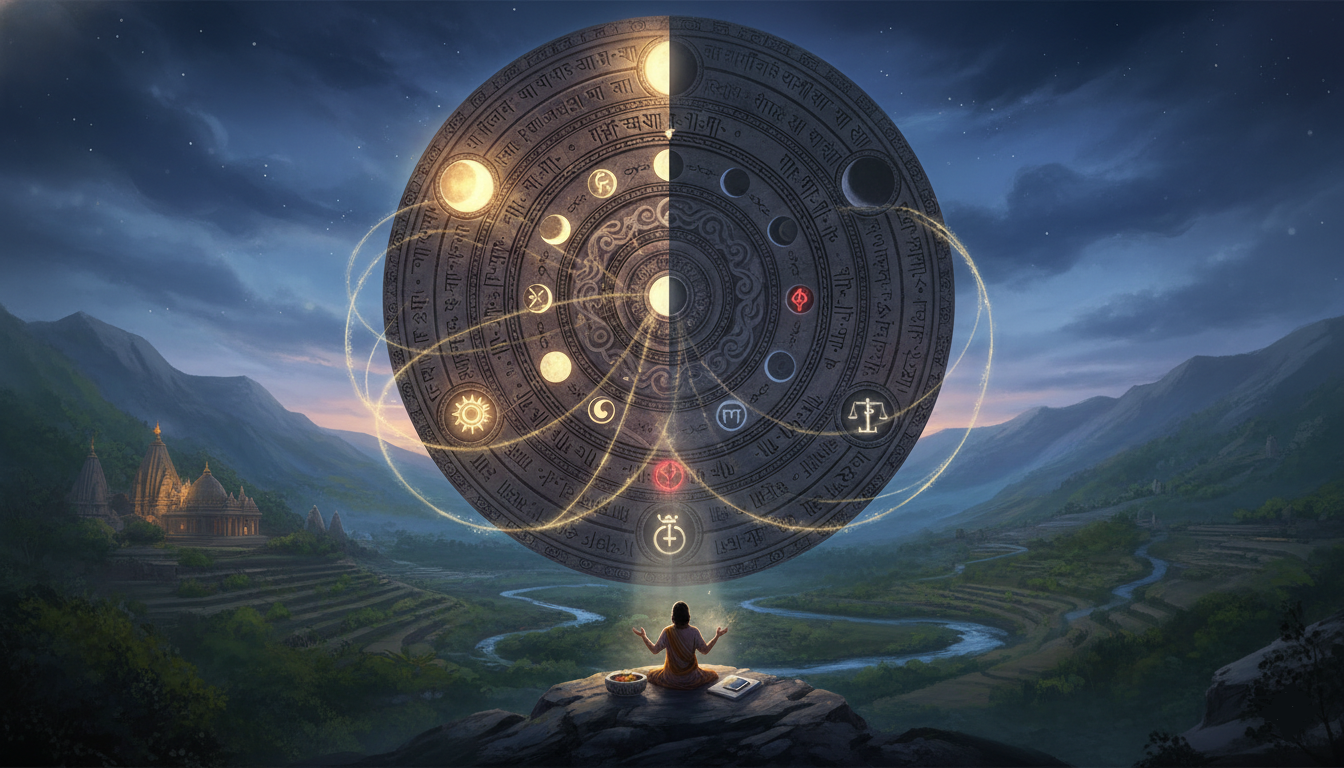
    The Panchanga (from the Sanskrit pancha-anga, meaning “five limbs”) is the ancient Vedic calendar. It’s like a daily cosmic weather report that describes the quality of time, helping you align your actions with the flow of the universe.

    Ancient Wisdom, Modern Application

    This guide blends the classical definitions of the Panchanga with contemporary, practical ways to use them for everyday planning. While traditionally used for timing important ceremonies, this framework is also a powerful tool for modern productivity and self-awareness. For formal events like weddings or vows, it’s always best to consult your family tradition and a qualified astrologer.


    1. Tithi (The Lunar Day): The Rhythm of Momentum

    What it is: The Tithi tracks the Moon’s journey away from the Sun. There are 30 Tithis in a lunar month—15 during the waxing phase (Shukla Paksha) as the Moon grows brighter, and 15 during the waning phase (Krishna Paksha) as it darkens.

    How to use it:

    • Waxing Moon (growing bigger): The energy is building. This is a supportive time for starting new projects, growth, and expansion.
    • Waning Moon (getting smaller): The energy is contracting. This is perfect for finishing tasks, editing, refining, and letting go.

    A Deeper Look: Technically, a Tithi marks each 12-degree increment of distance between the Sun and Moon. Because the Moon’s speed changes, a Tithi’s duration can vary, lasting anywhere from 19 to 26 hours.


    2. Vara (The Weekday): The Manager of the Day

    What it is: The Vara is the day of the week, ruled by a specific planet. Each planetary ruler sets the “managerial tone” for the day.

    How to use it: Aligning your tasks with the day’s planetary energy is a simple but powerful practice.

    DayRulerA Supportive Time For…
    SundaySunLeadership, setting goals, visibility, self-care.
    MondayMoonCommunity, nurturing, planning, connecting.
    TuesdayMarsTaking action, tackling hard tasks, exercise.
    WednesdayMercuryCommunication, learning, writing, data analysis.
    ThursdayJupiterStrategy, teaching, finances, big-picture thinking.
    FridayVenusCreativity, relationships, marketing, enjoyment.
    SaturdaySaturnDeep work, organizing, cleaning, long-term tasks.

    3. Nakshatra (The Lunar Mansion): The Soul of the Day

    What it is: This is the heart of the Panchanga. The Nakshatras are the 27 star constellations, or “lunar mansions,” that the Moon passes through. The Nakshatra the Moon is in today describes the day’s core archetype, mood, and personality.

    How to use it: Think of the Nakshatra as the day’s unique “character.” To give you a feel for their personalities, here are a few examples from the full system of 27:

    • Rohini: Creative and growth-oriented, supportive for planting seeds, starting a business, or launching a product.
    • Pushya: Known for its nourishing quality, its energy is ideal for learning, teaching, and acts of service.
    • Ashwini: Swift and healing, its energy is great for starting a new health routine or getting a quick start on a project.

    4. Yoga (The Energetic Filter): The Tone of the Day

    What it is: The Yoga is a special calculation based on the combined positions of the Sun and Moon. There are 27 Yogas, and they act like an energetic filter for the day.

    Yoga is computed as ((Sun longitude + Moon longitude) mod 360°) ÷ 13°20′, producing one of 27 nitya yogas. Traditions rate them differently; many are neutral-to-supportive, while several are cautionary. Vyatipata and Vaidhriti are widely treated as inauspicious for auspicious beginnings. On such days, favor introspection, planning, maintenance, or removals over inaugurations.


    5. Karana (The Micro-Timing): The “Go” Signal

    What it is: The Karana is the smallest unit, representing half of a Tithi. It provides a final layer of nuance for timing your actions within the day. For example, the Vanija karana has commerce connotations, and many practitioners find it supportive for business—not a guarantee, but a useful tie-breaker.

    The 7 movable karanas cycle in order—Bava → Balava → Kaulava → Taitila → Gara → Vanija → Vishti (Bhadra)—repeating eight times per lunation. The 4 fixed karanas occur once each month at specific halves: Kimstughna (Shukla Pratipada 1st), Shakuni (Krishna Chaturdashi 2nd), Chatushpada (Amavasya 1st), Naga (Amavasya 2nd).

    Vishti (Bhadra) is generally avoided for auspicious inaugurations; it’s powerful for obstacle-clearing, audits, and tough clean-ups.


    A Quick Note: Why Panchanga Apps Disagree

    You might notice that one app gives slightly different timings than another. This is normal! Different systems use different astronomical calculations (ayanamsas) or define the day differently. Traditional panchangas reckon the day from local sunrise to the next sunrise, so vara, tithi, yoga, and karana may change within the civil day. Modern apps that anchor to midnight can show different boundaries. The key is to pick one reliable source and stay consistent with it.


    Putting It All Together: A Simple Daily Practice

    1. Get a Panchanga App: Find one that feels clear to you.
    2. Check the Vitals: In the morning, take 60 seconds to look at the day’s Tithi, Vara, and Nakshatra.
    3. Align One Action: Choose just one thing on your to-do list that feels perfectly aligned with the day’s energy.

    What If the Factors Conflict?

    A good rule of thumb is to prioritize the day’s energy in this order: Nakshatra (the core story) → Tithi (the momentum) → Karana (the start moment). If a challenging Yoga is active, consider down-scoping your plans rather than canceling them.


    Final Thought: Time Isn’t Just a Clock

    The Panchanga teaches us that time isn’t a flat line. It has texture, quality, and personality. By learning to read this ancient map, you empower yourself to make wiser choices, reduce friction, and live a life that is more in tune with the beautiful, complex rhythm of the universe.

  • What’s Your Life’s Purpose? How Vedic Astrology Maps the 4 Aims of Life

    What’s Your Life’s Purpose? How Vedic Astrology Maps the 4 Aims of Life

    Are you a builder, a creator, a connector, or a seeker?

    We all have these drives within us, but for each of us, one or two often take the lead. Vedic astrology (Jyotisha) has a beautiful framework for understanding these core human motivations. It’s called the Purusharthas, or the Four Aims of a Meaningful Life.

    Your birth chart isn’t just a snapshot of the sky; it’s a personal map of these four aims. It shows which drives are most natural for you, when they are likely to be activated, and how you can live a more balanced, fulfilling life by honoring them.

    Let’s explore these four aims and how you can spot them in your own chart.


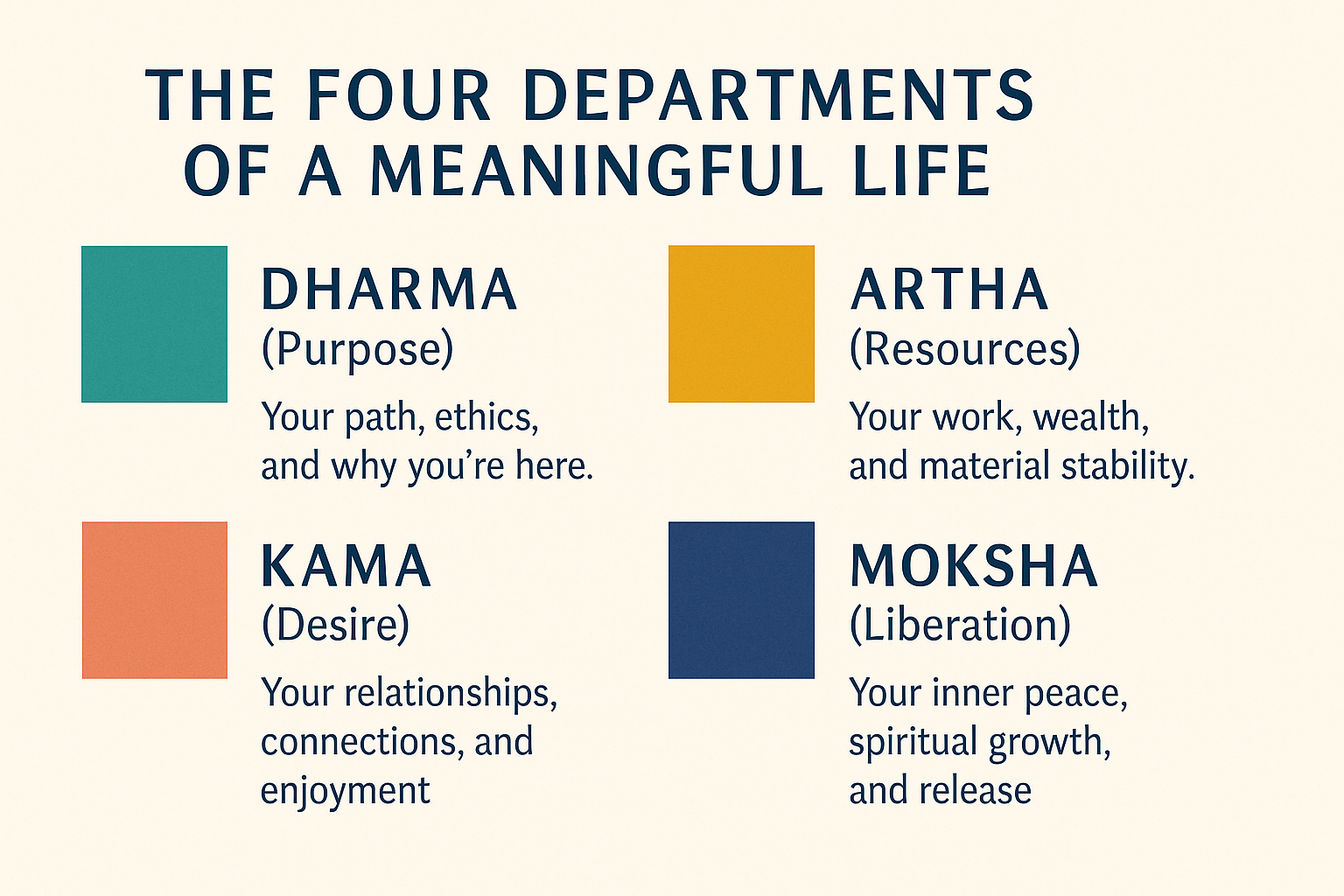
    The Four Departments of a Meaningful Life

    Think of these as the four essential departments of a complete human experience. All are necessary, but your chart will show where your energy is most concentrated.

    • Dharma (Purpose): Your path, ethics, and why you’re here.
    • Artha (Resources): Your work, wealth, and material stability.
    • Kama (Desire): Your relationships, connections, and enjoyment.
    • Moksha (Liberation): Your inner peace, spiritual growth, and release.

    Each of these aims is connected to a group of three houses in your chart.


    The Dharma Houses (1, 5, 9): Your Path & Purpose

    The core question: “Why am I here?”

    The Dharma houses are the pillars of your identity and personal mission. They represent your unique path, your creative intelligence, and the wisdom you gather along the way.

    • 1st House: Your core self, your body, and your approach to life.
    • 5th House: Your creativity, joy, intelligence, and legacy.
    • 9th House: Your beliefs, teachers, higher wisdom, and sense of meaning.

    When this area is strong in your chart, you are likely driven by a powerful sense of purpose. You thrive when you are learning, creating, teaching, and living in alignment with your personal truth.

    The Artha Houses (2, 6, 10): Your Work & Stability

    The core question: “How do I sustain myself and contribute?”

    The Artha houses are about the practical, material side of life. They govern your resources, your work, your health, and the skills you use to build a stable and secure existence.

    • 2nd House: Your wealth, values, speech, and what you consume.
    • 6th House: Your daily work, service, health routines, and problem-solving skills.
    • 10th House: Your career, reputation, and actions in the world.

    When this area is strong, you are a builder. You find fulfillment in meaningful work, providing for yourself and others, and creating tangible results in the world.

    The Kama Houses (3, 7, 11): Your Desires & Connections

    The core question: “What do I want, and who do I want to share it with?”

    The Kama houses are about your desires, ambitions, and relationships. This is the social and relational sphere of life, where you connect with others to achieve shared goals and find enjoyment.

    • 3rd House: Your courage, curiosity, personal initiative, and skills.
    • 7th House: Your romantic partnerships, business contracts, and one-on-one relationships.
    • 11th House: Your friendships, networks, community, and long-term aspirations.

    When this area is strong, you are a connector. You come alive through collaboration, social interaction, and pursuing your ambitions with the help of your allies.

    The Moksha Houses (4, 8, 12): Your Inner Freedom

    The core question: “What will set me free?”

    The Moksha houses represent the inner, psychological, and spiritual dimensions of life. This is where you heal, transform, and find true contentment by letting go of attachments and understanding your deeper self.

    • 4th House: Your emotional foundation, home, mother, and inner peace.
    • 8th House: Your deepest transformations, healing, psychology, and hidden knowledge.
    • 12th House: Your spiritual practices, retreat, dreams, and final liberation.

    When this area is strong, you are a seeker. Your path is internal, focused on emotional maturity, healing, and connecting with a reality beyond the material world.


    A Quick Note on “Karma”

    You might be wondering where “karma” fits in. Karma means action, and it runs through your entire chart. Every choice you make in every house is a karma. The 10th House has a special title, the Karma Bhava, because it represents your most visible actions in the world—your career and public life.


    How to Read This in Your Chart: A Simple 3-Step Process

    1. Find Your Focus: Look at your chart and do a quick count. Which group of houses (Dharma, Artha, Kama, or Moksha) holds the most planets? This reveals your natural, lifelong emphasis.
    2. Look at the Timing: Your focus isn’t static. In Vedic astrology, Dashas are planetary periods that act like “life chapters.” When the Dasha of a planet connected to your Artha houses begins, your career and finances will naturally take center stage.
    3. Aim for Balance, Not Perfection: The goal isn’t to be 100% focused on all four aims at once. It’s about recognizing which “department” needs your attention now and honoring it, without completely neglecting the others.

    Your 5-Minute Chart Check-In

    Ready to try it? Grab your chart.

    1. Circle the planets in your Dharma houses (1, 5, 9).
    2. Box the planets in your Artha houses (2, 6, 10).
    3. Underline the planets in your Kama houses (3, 7, 11).
    4. Star the planets in your Moksha houses (4, 8, 12).

    Which group stands out the most? What does that tell you about your core nature?

    Now, pick one micro-action you can take today to honor each aim:

    • Dharma: Read an inspiring article or share something you know.
    • Artha: Complete one practical task on your to-do list.
    • Kama: Send a thoughtful message to a friend or collaborator.
    • Moksha: Spend 5 minutes journaling or sitting in silence.

    Final Thought: Your Chart is a Map of Priorities

    Your birth chart doesn’t lock you into a single destiny—it gives you a map of your soul’s priorities. By understanding whether you’re in a season of Dharma, Artha, Kama, or Moksha, you can stop fighting the cosmic current and start flowing with it.

    When you align your daily actions with the deeper themes of your life, you find more meaning, less resistance, and a powerful sense of coming home to yourself.

  • How to Read a Vedic Astrology Chart (North Indian Style): A Beginner’s Guide

    How to Read a Vedic Astrology Chart (North Indian Style): A Beginner’s Guide

    So, you’ve generated your first Vedic astrology chart, and now you’re staring at a dazzling diamond of lines, numbers, and cryptic symbols. It looks fascinating, but also… a little intimidating. Where do you even begin?

    Don’t worry. The North Indian chart style might look complex, but it follows a few simple, consistent rules. Once you learn them, you’ll be able to navigate any chart with confidence.

    In this guide, we’ll walk you through it step-by-step. In less than 10 minutes, you’ll understand the basic anatomy and logic of your own personal cosmic map.


    The Two Golden Rules of the North Indian Chart

    Before we go anywhere, let’s learn the two “golden rules.” If you remember these, you’ll never get lost.

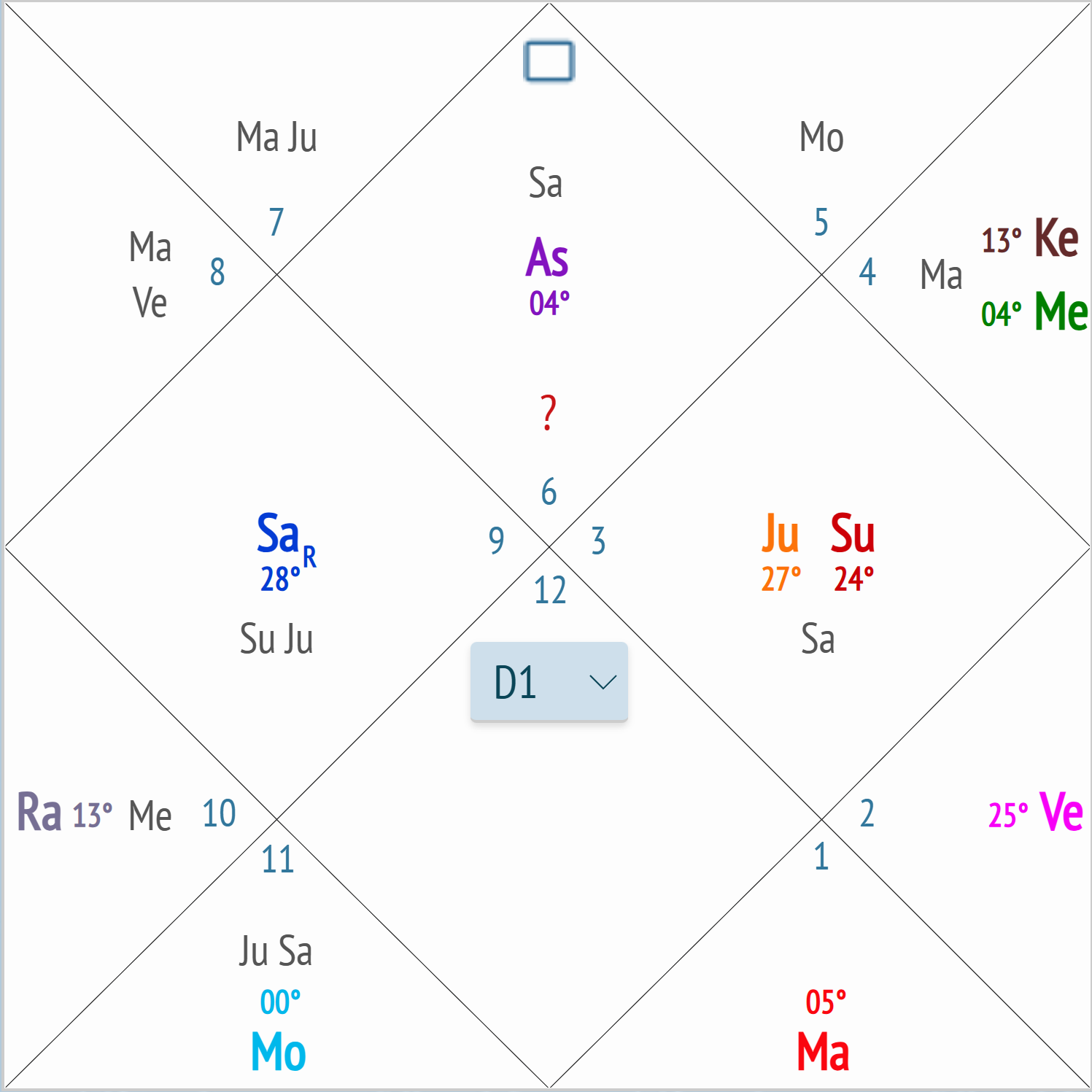
    Rule #1: The Houses Are Fixed. Think of the chart as a building with 12 rooms. The rooms (the houses) never, ever move. The First House is always at the top, the Second House is always to its left, and so on.

    Rule #2: The Signs Rotate. While the rooms are fixed, the decorations inside them (the zodiac signs) change for every person. The numbers you see printed in the boxes tell you which sign falls into which fixed room in your unique chart.

    That’s it! Houses are fixed places; signs are the energies that occupy those places.


    Step 1: Find Your Starting Point (The Ascendant)

    Everything in your chart begins with the Ascendant, also known as the Lagna. This is your personal horizon at the moment of your birth, and it represents you—your body, your personality, and your approach to life.

    In a North Indian chart, the Ascendant is always the top-center diamond. This box is your First House.


    Step 2: Count the Houses (Always Counter-Clockwise!)

    From the First House at the top, the other houses follow in a simple, predictable order: counter-clockwise.

    The box to the left of the Lagna is the 2nd House, the next one is the 3rd, and so on, all the way around to the 12th House, which is the box to the right of the Lagna.

    This order never changes. Memorize this flow, and you’ll instantly know which area of life each box represents.


    Step 3: Decode the Numbers (These Are Signs, Not Houses!)

    This is the most common stumbling block for beginners, so let’s make it crystal clear. The small numbers printed inside the boxes are not house numbers. They are ZODIAC SIGN numbers.

    Since the houses are fixed, these numbers tell you which sign occupies which house.

    • 1 = Aries
    • 2 = Taurus
    • 3 = Gemini
    • 4 = Cancer
    • 5 = Leo
    • 6 = Virgo
    • 7 = Libra
    • 8 = Scorpio
    • 9 = Sagittarius
    • 10 = Capricorn
    • 11 = Aquarius
    • 12 = Pisces

    So, if you see a “5” in the top-center diamond, it means you have a Leo Ascendant (Leo is in your First House). If you see a “10” in the box on the far left, it means you have Capricorn in your Fourth House.


    Step 4: Put It All Together (Planet in Sign in House)

    Now for the fun part! You’ll see little abbreviations for planets (like Su for Sun, Mo for Moon, Sa for Saturn) placed in the boxes. This is where you start to read your story.

    The basic formula is:
    Planet’s Energy + Sign’s Style + House’s Topic = Your Unique Experience

    Let’s try an example. Imagine you see Ve (Venus) in the box on the far right of the chart (the 10th House), and that box contains the sign number 7 (Libra).

    • Planet: Venus (love, harmony, beauty, relationships)
    • Sign’s Style: In Libra (diplomatic, balanced, artistic, social)
    • House’s Topic: In the 10th House (career, public status, actions in the world)

    The Reading: Your career and public life (10th House) are best expressed through diplomacy, partnerships, and creativity (Venus in Libra). You might thrive in a field related to art, design, law, or counseling.


    A Quick Note: North vs. South Indian Charts

    If you explore Jyotisha, you’ll also see a square-shaped South Indian chart. Don’t get confused! They show the exact same information, just with a different layout.

    • North Indian (this guide): Houses are fixed, signs rotate.
    • South Indian: Signs are fixed, houses rotate.

    It’s like having two different map styles for the same city. Most people find one style clicks better for them.


    Start Exploring Your Chart

    You now have the fundamental rules to navigate your North Indian chart. It’s no longer an intimidating puzzle; it’s a map waiting to be explored.

    1. Find your Lagna (Ascendant) in the top diamond. What sign number is there?
    2. Count counter-clockwise to find your 7th House (relationships) and 10th House (career). What signs are in them?
    3. Look for where the Moon (Mo) is placed. The house, sign, and any other planets there will tell you a rich story about your inner world.

    Welcome to the start of a fascinating journey. Be patient, be curious, and let the science of light illuminate your path.

  • Why Your Zodiac Sign Might Be Different in Vedic Astrology

    Why Your Zodiac Sign Might Be Different in Vedic Astrology

    You’ve known your whole life that you’re a Leo. It’s on your favorite coffee mug, you read the horoscopes, and you’ve always vibed with that fiery, main-stage energy.

    But what if you pulled up a Vedic astrology chart and it told you that you’re actually a… Cancer?

    Before you have an identity crisis, let’s clear things up. Your sign didn’t really change—you just looked at the sky through a different window. That window is the Sidereal Zodiac, the foundation of Vedic astrology, and it offers a powerful new perspective on who you are.

    Let’s break down the difference between the two zodiacs and why it matters.


    The Two Zodiacs: A Tale of Two Starting Points

    At its core, the difference is simple. Both systems map the same sky, but they start counting from a different “zero point.”

    The Tropical Zodiac (Used in Western Astrology)

    Think of this as the Seasonal Zodiac. Its starting point (0° Aries) is locked to the Spring Equinox in the Northern Hemisphere. It’s a beautiful system that reflects the Earth’s relationship with the Sun and the changing of the seasons.

    The Sidereal Zodiac (Used in Vedic Astrology)

    Think of this as the Star Zodiac. Its starting point is anchored to the actual, visible constellations in the night sky. It’s a map of where the planets are in relation to the stars themselves.

    The Easiest Analogy:The Tropical Zodiac is like a calendar, marking time by the seasons.The Sidereal Zodiac is like a star map, marking location by the constellations.


    So, Why Are They 24 Degrees Apart?

    Here’s the cosmic twist: the Earth has a slow wobble, like a spinning top losing steam. This is called precession.

    Over thousands of years, this wobble causes the Spring Equinox to drift backward against the backdrop of the stars.

    • The Tropical Zodiac moves with the equinox, so 0° Aries is always the first day of spring.
    • The Sidereal Zodiac stays with the stars, ignoring the seasonal shift.

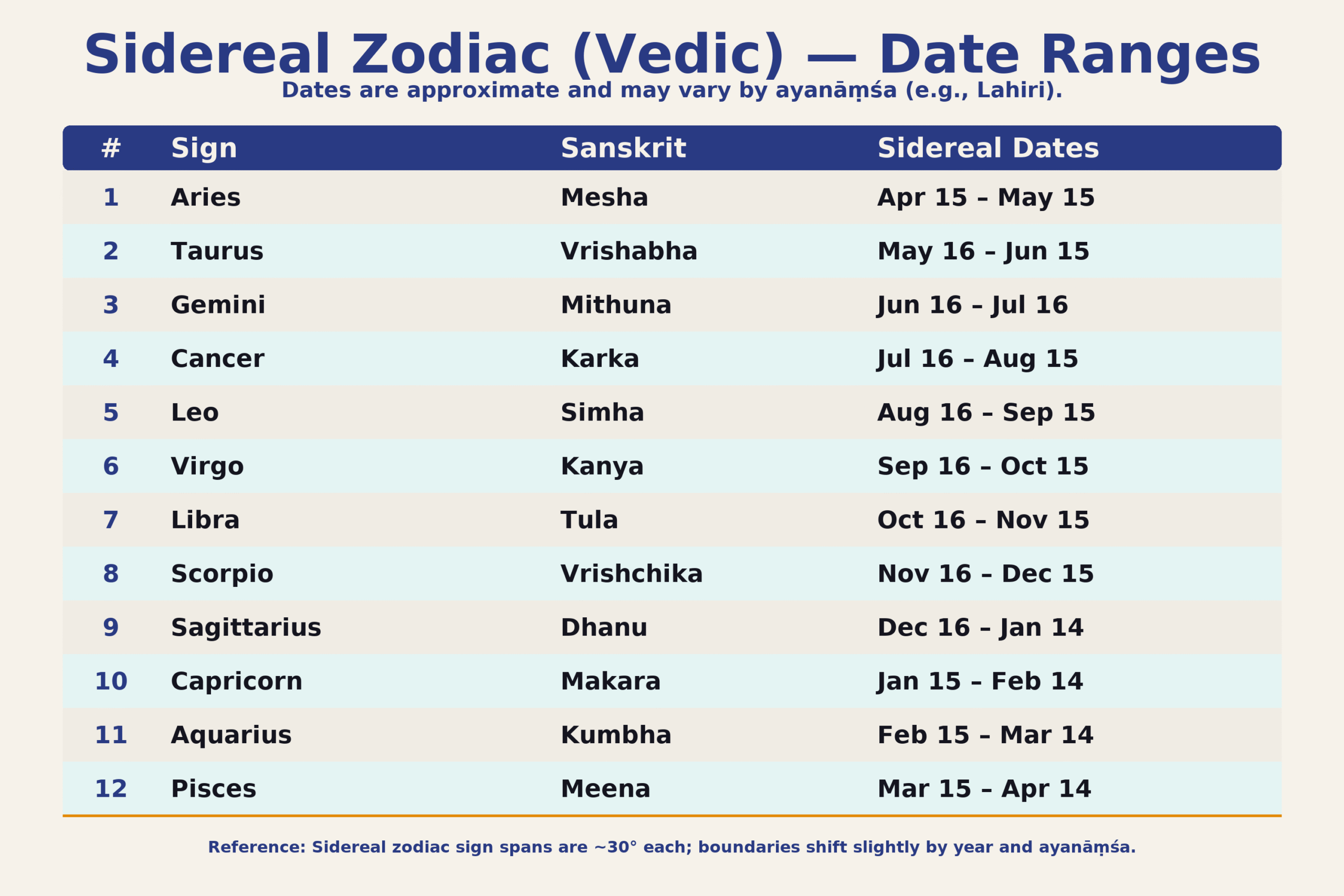
    Today, this slow drift has created a gap of about 24 degrees between the two systems. This gap is called the ayanamsa.


    Okay, But What Does This Mean for Me?

    That 24-degree difference is a big deal. Since each zodiac sign is 30 degrees wide, this gap is enough to shift many of your planetary placements—including your “Big Three”—into the previous sign.

    1. Your Core Identity Might Get a New Flavor

    Your Sun Sign (your core self), Moon Sign (your emotional world), and Ascendant/Rising Sign (how you meet the world) could all change. That Leo Sun might become a Cancer Sun in your Sidereal chart. This doesn’t mean your Western chart was “wrong.” It simply means the Sidereal lens might highlight your more nurturing, sensitive, and private Cancerian qualities. Many people find that the Sidereal placement reveals a deeper, more private layer of themselves.

    2. The Strength of Your Planets Changes

    In Vedic astrology, a planet’s strength is heavily influenced by the sign it’s in. A planet that feels powerful and at home in one sign might feel challenged in another. This shift can offer a whole new understanding of your natural strengths and where you face your biggest lessons.

    3. The Focus of Your Life Shifts

    Your Ascendant (or Rising Sign) sets the stage for your entire life, marking the First House. If your Ascendant shifts from Libra to Virgo, the focus of every area of your life (career, relationships, family) gets a new spin.


    So, Which Zodiac Is “Right”?

    This is the most important question, and the answer is: both are right.

    They are two different, internally consistent systems designed to do different things. The better question is: Which tool do you need right now?

    • If you love exploring personality through the lens of seasons and psychological archetypes, the Tropical Zodiac is a brilliant tool.
    • If you want to explore the ancient Vedic techniques of timing, karma, and remedies that are tied to the constellations (like the Nakshatras), the Sidereal Zodiac is the way to go.

    Many modern astrologers use both! At Psyveda, we focus on the Sidereal system because it’s the foundation for all the predictive and remedial tools within Jyotisha.


    How to Find Your Sidereal Chart in 60 Seconds

    Curious to see your chart? It’s easy.

    1. Grab your birth info: You’ll need your exact date, time, and place of birth.
    2. Use an online calculator: Search for a “Vedic Astrology Chart Calculator.”
    3. Select the right settings: Make sure the zodiac is set to “Sidereal” and the ayanamsa is “Lahiri” (it’s the most common).
    4. Find your Big Three: Look for your Lagna (Ascendant), your Moon Sign, and your Moon Nakshatra. These are the cornerstones of a Vedic reading.

    Now, compare it to your Western chart. What feels different? What feels surprisingly familiar?


    Common Questions, Clear Answers

    “Was my Western chart wrong this whole time?”
    Not at all! You just looked at the sky through a different lens. It’s like describing a location with a street address versus GPS coordinates. Both lead to the same place, but they use a different reference system.

    “What’s this about a 13th sign, Ophiuchus?”
    Both the Tropical and Sidereal zodiacs are systems that divide the sky into 12 equal 30-degree signs. Ophiuchus is a constellation that the Sun passes through, but it is not one of the 12 signs in either astrological system.

    “Which ayanamsa should I use?”
    Lahiri is the most common and a great place to start. If you begin working with a specific teacher, they may use another one. The key is to pick one and stay consistent.


    Final Thought: A New Layer of You

    Exploring your Sidereal chart isn’t about erasing what you know about yourself—it’s about adding a new, profound layer to your self-awareness. It connects you to the ancient tradition of watching the stars and offers a practical, time-tested way to navigate the seasons of your life.

    Why not give it a look? You might just discover a part of yourself you always knew was there, but never had a name for.

  • What Is Vedic Astrology? A Beginner’s Guide to the ‘Science of Light’

    What Is Vedic Astrology? A Beginner’s Guide to the ‘Science of Light’

    Have you ever felt that there’s a deeper rhythm to your life? A cosmic clock ticking behind the scenes? Welcome to Jyotisha, the traditional astrology of India.

    Its name translates to the ‘science of light.’ It uses the light of the planets and stars not just to understand your personality, but to illuminate the unique path and timing of your life’s journey.

    Think of your birth chart as your personal cosmic blueprint. Jyotisha provides the tools to read that blueprint, helping you understand your strengths, navigate challenges, and act when the timing is right. It’s a practical system for living a more conscious and aligned life.


    The #1 thing to know first: A different zodiac

    Before we dive in, there’s one key difference between Jyotisha and most Western astrology: the zodiac they use.

    • Jyotisha uses the Sidereal Zodiac. This zodiac is “fixed” to the stars and aligns with the actual constellations in the sky.
    • Western Astrology uses the Tropical Zodiac. This zodiac is “seasonal” and is fixed to the start of spring in the Northern Hemisphere.

    Because of precession, the two zodiacs are currently ~24° apart (using the common Lahiri ayanamsa). The exact offset varies slightly by ayanamsa and increases slowly over time. This means your Sun, Moon, or Ascendant sign may be in the previous sign in your Jyotisha chart. If you’ve always been a Libra, you might be a Virgo here. And that’s okay! It’s simply a different, equally valid frame of reference.


    The Four Core Pillars of Your Jyotisha Chart

    Your chart is built from four key components that work together to tell your story.

    1. The Grahas (The 9 Celestial Bodies)

    In Jyotisha, the main players are called Grahas (“seizers” or celestial influencers). They represent core energies and drives within you. This group includes the Sun, the Moon, and the lunar nodes Rahu and Ketu—they’re not limited to just astronomical planets.

    • Sun: Your soul, ego, and vitality.
    • Moon: Your mind, emotions, and inner peace.
    • Mars: Your energy, action, and courage.
    • Mercury: Your intellect, communication, and curiosity.
    • Jupiter: Your wisdom, luck, and expansion.
    • Venus: Your love, creativity, and pleasure.
    • Saturn: Your discipline, responsibility, and reality.
    • Rahu (desire, amplification) & Ketu (release, insight): The karmic axis.

    2. The Rasis (The 12 Zodiac Signs)

    These are the 12 backdrops of the zodiac. If the Grahas are the actors, the Rasis are the roles they play or the costumes they wear. Each sign gives the Graha within it a unique quality and style of expression.

    • Mesha (Aries): Action, pioneering, impulsive.
    • Vrishabha (Taurus): Stability, sensual, grounded.
    • Mithuna (Gemini): Curious, communicative, playful.
    • Karka (Cancer): Nurturing, emotional, protective.
    • Simha (Leo): Regal, creative, leadership.
    • Kanya (Virgo): Analytical, detailed, service-oriented.
    • Tula (Libra): Harmony, partnership, diplomatic.
    • Vrishchika (Scorpio): Intense, transformative, deep.
    • Dhanu (Sagittarius): Optimistic, philosophical, adventurous.
    • Makara (Capricorn): Ambitious, structured, disciplined.
    • Kumbha (Aquarius): Innovative, humanitarian, unconventional.
    • Mina (Pisces): Intuitive, compassionate, spiritual.

    3. The Bhavas (The 12 Houses)

    If the Grahas are actors playing roles (Rasis), the Bhavas are the stages where the action happens. Houses are read from the Lagna (Ascendant); the 1st house starts at the Lagna, and the rest follow in zodiacal order.

    • 1st: Self, body, vitality, approach to life
    • 2nd: Wealth, speech, values, food, family
    • 3rd: Effort, siblings, skills, courage
    • 4th: Home, mother, property, inner security
    • 5th: Children, creativity, intelligence, romance
    • 6th: Health, debts, service, obstacles (and overcoming them)
    • 7th: Relationships, spouse, contracts, public dealings
    • 8th: Transformation, longevity, shared resources, the hidden
    • 9th: Dharma, teachers, higher learning, fortune
    • 10th: Career, status, actions in the world
    • 11th: Gains, networks, aspirations
    • 12th: Loss, expenditure, liberation, foreign places, sleep

    4. The Nakshatras (The 27 Lunar Mansions)

    This is the secret spice of Jyotisha. The zodiac is further divided into 27 constellations called Nakshatras. The Nakshatra your Moon was in at birth provides a deep, nuanced look into your emotional nature and life path. (Jyotisha primarily uses 27 nakshatras, though some traditions acknowledge a 28th, Abhijit, for specific uses.)


    Your Personal North Star: The Lagna (Ascendant)

    The single most important point in your chart is the Lagna. This is the zodiacal sign that was rising on the eastern horizon at your birth. The Lagna is the lens through which you experience your entire life, representing your physical body and core temperament.


    The Magic of Timing: How Jyotisha Predicts

    This is where Jyotisha truly shines. It uses a sophisticated system to map out the “seasons” of your life.

    Dashas (Your Life Chapters)

    The Vimshottari Dasha system divides your life into planetary periods (e.g., a 20-year Venus Dasha, a 6-year Sun Dasha). The planet ruling your current “chapter” sets the main theme.

    Transits

    Transits are the current, real-time movements of the Grahas. When a transiting Graha passes over a key point in your chart, it activates it.

    Rule of Thumb: The dasha indicates what is possible in a life chapter; transits time when those promised themes ripen.


    What Can Jyotisha Help You With?

    • Timing: When is the best time to change careers, move, or get married?
    • Strategy: What career path aligns with my natural talents?
    • Self-Knowledge: What are my hidden strengths and karmic lessons?
    • Remedies: Remedies (like charity, mantra, disciplined routines) are meant to support wise action, not replace it.

    Common Myths, Debunked

    • Myth: “Bad” planets (like Saturn) mean a bad life.
      • Reality: These Grahas build strength and discipline. They are challenging, but they forge your greatest successes.
    • Myth: It’s all fatalistic.
      • Reality: Your chart shows the landscape and the weather, but you have free will to choose how you navigate it. Jyotisha is about empowerment.

    How to Get Started

    1. Find Your Accurate Birth Info: You need your exact date, location, and, most importantly, time of birth.
    2. Generate Your Chart: When generating your chart, select Sidereal (Lahiri ayanamsa). Other ayanamsas (e.g., Krishnamurti, Raman) exist; pick one and stay consistent.
    3. Identify the Basics: Find your Lagna, your Moon Sign (Chandra Rasi), and your Moon Nakshatra.
    4. Check Your Current Dasha: Find out which planetary “chapter” you’re in. This tells you the main theme of your life right now.

    Frequently Asked Questions

    Q: Will my signs really change from my Western chart?
    A: Very likely, yes. Because Jyotisha uses the Sidereal zodiac, your Sun, Moon, and Ascendant signs may shift back into the previous sign. It’s a new perspective to explore!

    Q: What if I don’t know my exact birth time?
    A: An accurate birth time is crucial. If you’re unsure, a professional Jyotisha astrologer can perform a “chart rectification” to help determine the correct time.

    Q: Is Jyotisha hard to learn?
    A: It’s deep, but you can learn the basics quickly. Start with your Ascendant, your Moon, and your current Dasha lord. Mastering these will give you 80% of the core story.