
Tag: complexes

  • Why Little Things Feel So Big: A Guide to Emotional Triggers in Your Relationships

    Why Little Things Feel So Big: A Guide to Emotional Triggers in Your Relationships

    Have you ever had a tiny moment in a relationship feel disproportionately huge? Your partner replies with a one-word text, and you spiral into anxiety. Your friend changes plans last minute, and you’re filled with a surprising amount of rage.

    These moments are often called emotional or relational triggers. In this article, we’ll use the term “shadow triggers” as a simple teaching frame to explore them through a Jungian lens.

    The psychiatrist C.G. Jung described the “shadow” as the parts of ourselves we’ve disowned or can’t consciously identify with. A shadow trigger is a present-day moment that pokes that hidden material—unleashing an emotional reaction that’s often far bigger than the situation itself. These moments often involve a cocktail of psychological dynamics:

    • Projection: A concept from early psychoanalysis where we see our own unacknowledged traits in others.
    • Complexes: A core Jungian idea describing emotionally charged themes (like worth or abandonment) that can hijack our responses.
    • Transference: A term from psychoanalysis where we relate to a current person as if they were someone from our past.

    Understanding your triggers isn’t about blaming yourself for being “too sensitive.” It’s about seeing them as signposts, pointing you toward the parts of yourself that are ready to be understood and healed.


    12 Common Triggers and What They’re Really About

    Triggers are rarely about the thing itself; they’re about the old story the thing activates. Here are 12 common examples.

    1. Being Ignored or Delayed Replies:
      • The Deeper Nerve: A fear of abandonment or a feeling of unworthiness.
    2. Last-Minute Plan Changes:
      • The Deeper Nerve: A feeling of powerlessness or a reactivation of childhood unpredictability.
    3. Receiving Constructive Feedback:
      • The Deeper Nerve: A core belief of being defective or a fear that you must be perfect to be loved.
    4. Getting a Compliment:
      • The Deeper Nerve: This often points to the “golden shadow”—a post-Jungian idea popularized by Robert A. Johnson, which refers to positive strengths you’ve disowned.
    5. Your Partner’s Success:
      • The Deeper Nerve: Envy and a fear of being left behind.
    6. Talking About Money:
      • The Deeper Nerve: Deep-seated fears around security, power, and fairness.
    7. Mismatched Libidos or Desire:
      • The Deeper Nerve: A profound fear of rejection or shame.
    8. Jealousy:
      • The Deeper Nerve: Old wounds of betrayal or a pattern of self-comparison.
    9. Unfair Division of Labor:
      • The Deeper Nerve: A feeling of being invisible or taken for granted.
    10. Silence or Withdrawal:
      • The Deeper Nerve: A fear of emotional neglect or a feeling that conflict is unsafe.
    11. Different Social Needs (Introvert vs. Extrovert):
      • The Deeper Nerve: The fear of being “too much” or “not enough.”
    12. Phone/Tech Boundaries:
      • The Deeper Nerve: A feeling of unworthiness—that you are less interesting than a screen.

    How to Work With Your Triggers: A Practical Loop

    The next time you feel that emotional surge, don’t just react. Pause and get curious.

    Before You Start: Is It Just a Trigger?

    Disproportionate reactions can arise from many sources. Before diving into shadow work, check in: Is your reaction also influenced by physiology (sleep debt, hunger), attachment injuries, past trauma, or even neurodivergence? This guide is for exploring patterns, not for self-diagnosing.

    1. Name the Facts: What actually just happened, without any story? (e.g., “My partner looked at their phone while I was talking.”)
    2. Name the Feeling: What emotion came up for you? (e.g., Sadness, anger, loneliness.)
    3. Spot the Story: What story did you immediately tell yourself? (e.g., “They don’t care about what I’m saying.”)
    4. Find the History: Where is this feeling or pattern familiar from your past?
    5. Make a Clear Request or Boundary: Based on your need, what is one clear, kind, and specific thing you can ask for?

    A Note on Safety: When to Seek Professional Support

    While this framework is powerful for everyday triggers, it’s crucial to distinguish them from responses to real harm. If your reaction is to disrespect, coercion, or abuse, the issue is not your shadow—it’s the other person’s behavior.

    Disproportionate reactions can arise from many sources. If triggers are frequent, intense, or impair your work, sleep, or sense of safety, consider seeking support from a licensed, trauma-informed clinician.


    Final Thought: Your Triggers Are Your Teachers

    Your emotional triggers are not a sign that you or your partnership is broken. They are simply messengers from the deepest parts of yourself, asking for attention and healing.

    Every time you pause, breathe, and choose to respond with curiosity instead of reactivity, you are not only healing yourself—you are building a relationship strong enough to hold all of who you are, shadow and light.
  • Who Am I, Really? A Beginner’s Guide to the Mind-Bending World of C.G. Jung

    Who Am I, Really? A Beginner’s Guide to the Mind-Bending World of C.G. Jung

    Have you ever wondered why you’re drawn to certain stories, symbols, or dreams? Do you sometimes feel like there’s a hidden, wiser part of yourself trying to get your attention? If so, you’re already asking the kinds of questions that fascinated one of the most influential thinkers of the 20th century: Carl Gustav Jung.

    Jung was a Swiss psychiatrist who believed that the human psyche was not just a collection of repressed memories and drives, but a vast, creative, and spiritual ecosystem. He gave us a map to explore our inner worlds, and his ideas are more relevant today than ever.

    This guide will walk you through the core concepts of Jungian psychology in a simple, practical way.

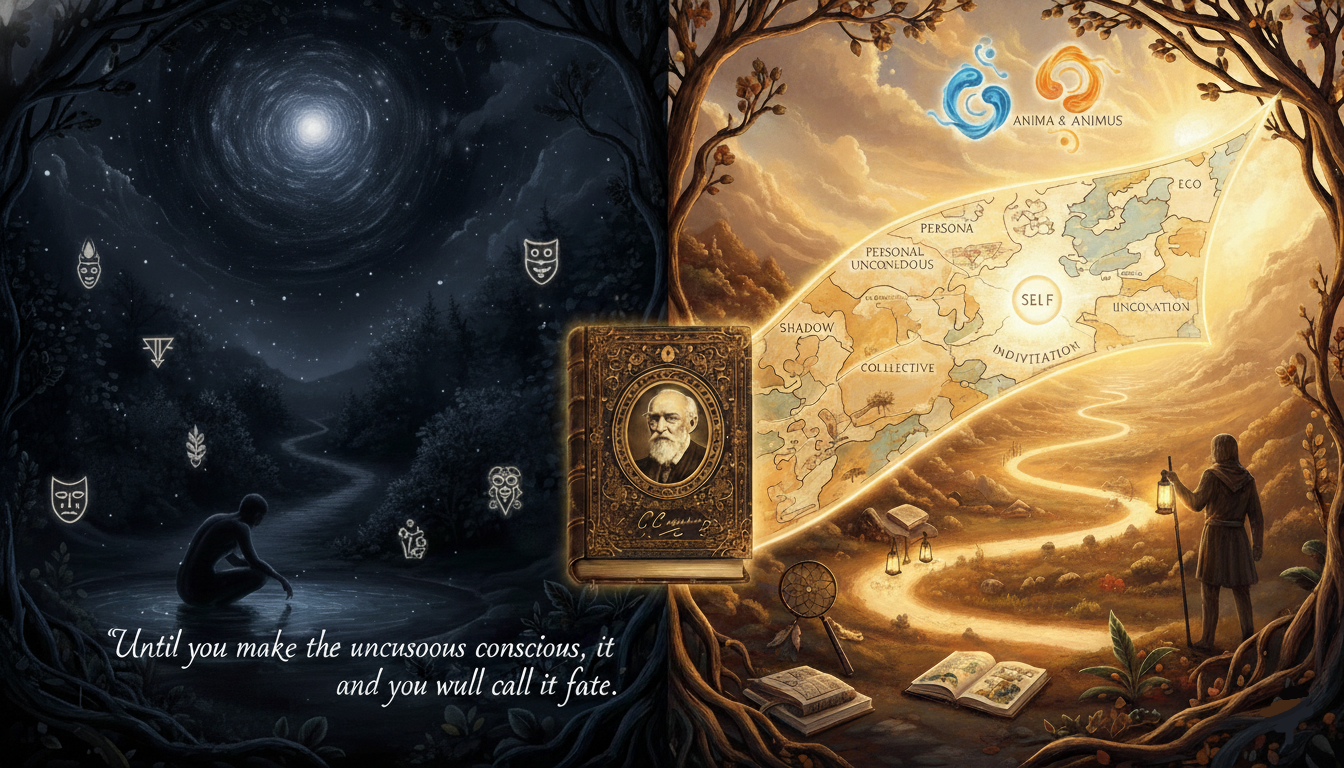
    As Jung’s ideas suggest, “Until you make the unconscious conscious, it will direct your life and you will call it fate.” (a popular paraphrase of Jung’s idea in Aion).


    The Map of Your Mind: How Jung Saw the Psyche

    Jung believed our psyche has several distinct layers, each playing a vital role in who we are.

    1. The Ego & The Persona (The “You” You Show the World)

    • The Ego: This is your conscious mind, the part of you that says “I.” It’s your center of identity, making decisions and navigating daily life.
    • The Persona: This is your social mask. It’s the polished, professional, or “nice” version of yourself you present to others. It’s a necessary tool for social harmony, but problems arise when we mistake our mask for our true self.

    2. The Shadow (The “You” You Hide)

    The Shadow is the part of your unconscious that contains all the traits you’ve disowned or repressed. This isn’t just “bad” stuff like anger or jealousy. Often, our greatest strengths—our creativity, our ambition, our wildness—are also hidden in the shadow. Jung believed that true growth comes not from ignoring the shadow, but from turning to face it.

    “One does not become enlightened by imagining figures of light, but by making the darkness conscious.” — C.G. Jung (Alchemical Studies, CW 13)

    3. The Personal & Collective Unconscious (The Deep Waters)

    • Personal Unconscious: This holds your own forgotten memories, experiences, and repressed feelings.
    • Collective Unconscious: This was one of Jung’s most groundbreaking ideas. He proposed that all of humanity shares a deep, inherited layer of the unconscious, filled with universal patterns and symbols called archetypes.

    The Archetypes: Universal Characters on Your Inner Stage

    Archetypes are the universal characters that live in the collective unconscious and show up in myths, fairy tales, and our dreams. Think of the Hero, the Wise Old Woman, the Trickster, or the Great Mother. Other powerful archetypes, like the Child (symbolizing innocence or potential) or the Shadow itself, also shape our psyche.

    These aren’t just characters in stories; they are living energies within you. Understanding which archetypes are active in your life can give you profound insight into your motivations and challenges.

    Anima & Animus (Your Inner Counterpart)

    Jung also identified two crucial archetypes that represent our inner “other.” While Jung originally described the anima as the feminine aspect in men and the animus as the masculine aspect in women, modern interpretations often see these as universal energies, like yin and yang, present in everyone. Connecting with this inner counterpart is key to wholeness.


    Individuation: The Journey to Becoming Yourself

    For Jung, the ultimate goal of life was individuation. This is the lifelong process of becoming the most whole, authentic, and complete version of yourself.

    It’s not about becoming “perfect.” It’s about integrating all the different parts of your psyche—your ego, your shadow, your anima/animus—into a balanced and functional whole, guided by a deeper center he called the Self.

    “The self is our life’s goal, for it is the completest expression of that fateful combination we call individuality.” — C.G. Jung (Two Essays on Analytical Psychology, CW 7)


    Practical Tools for Your Jungian Journey

    Jung didn’t just give us a map; he gave us tools to explore the territory.

    1. Dreamwork

    Jung saw dreams as letters from the unconscious. Instead of using a dream dictionary, he encouraged a process of amplification: connecting the images in your dream to myths, fairy tales, and your personal life to uncover their unique meaning for you.

    2. Shadow Work

    This is the courageous practice of looking at the parts of yourself you’d rather ignore. A simple way to start is to notice what you judge most harshly in others. Often, the things that irritate us most in other people are disowned parts of our own shadow.

    3. Active Imagination

    This is a powerful technique of consciously dialoguing with the figures and symbols that emerge from your unconscious through journaling, drawing, or even movement. It’s a way to build a direct relationship with your inner world.


    How to Start Today: A Simple Shadow Work Exercise

    You don’t need to be a scholar to begin working with these ideas. Try this one:

    1. Notice a Strong Reaction: Think of someone who really “pushes your buttons” or a character you strongly admire.
    2. Name the Trait: What is the specific quality in them that triggers such a strong reaction? (e.g., “They are so arrogant,” or “They are so free-spirited.”)
    3. Find the Echo: Ask yourself, gently and without judgment: “Where is a tiny echo of that trait in me? Is there a part of me that longs to be more free-spirited, or a part that I’ve suppressed for fear of being seen as arrogant?”

    This is the beginning of shadow work—reclaiming the lost and hidden parts of yourself to become more whole.


    Final Thought: Your Inner World is an Adventure

    Jung invites us on the greatest adventure of all: the exploration of our own psyche. He reminds us that our inner world is not a problem to be solved, but a rich, living landscape to be explored. By looking within, we don’t just find ourselves; we find a connection to a story that is ancient, universal, and profoundly meaningful.

    “Who looks outside, dreams; who looks inside, awakes.” — C.G. Jung (Letters, Vol. 1, 1906–1950)