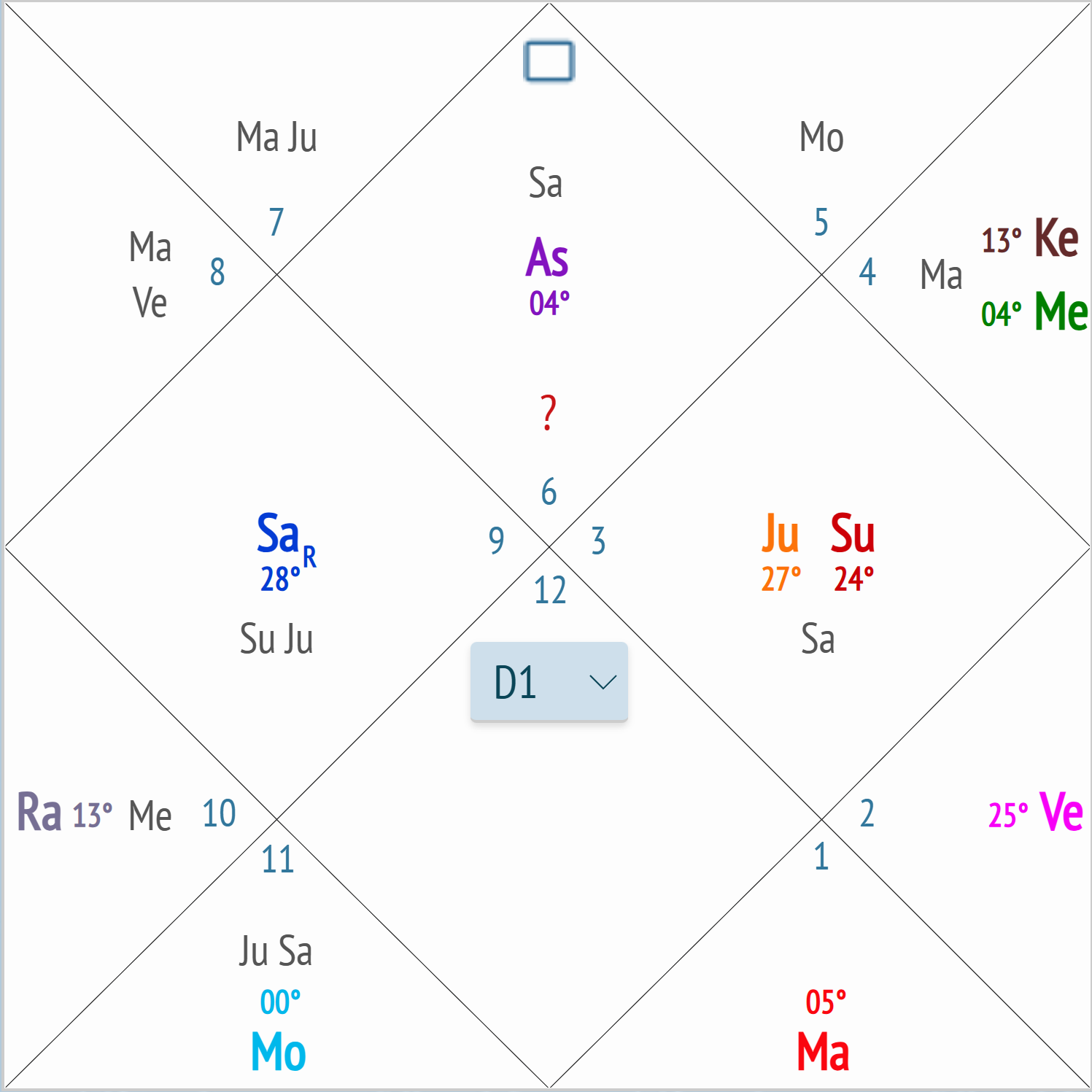
So, you’ve generated your first Vedic astrology chart, and now you’re staring at a dazzling diamond of lines, numbers, and cryptic symbols. It looks fascinating, but also… a little intimidating. Where do you even begin?
Don’t worry. The North Indian chart style might look complex, but it follows a few simple, consistent rules. Once you learn them, you’ll be able to navigate any chart with confidence.
In this guide, we’ll walk you through it step-by-step. In less than 10 minutes, you’ll understand the basic anatomy and logic of your own personal cosmic map.
The Two Golden Rules of the North Indian Chart
Before we go anywhere, let’s learn the two “golden rules.” If you remember these, you’ll never get lost.
Rule #1: The Houses Are Fixed. Think of the chart as a building with 12 rooms. The rooms (the houses) never, ever move. The First House is always at the top, the Second House is always to its left, and so on.
Rule #2: The Signs Rotate. While the rooms are fixed, the decorations inside them (the zodiac signs) change for every person. The numbers you see printed in the boxes tell you which sign falls into which fixed room in your unique chart.
That’s it! Houses are fixed places; signs are the energies that occupy those places.
Step 1: Find Your Starting Point (The Ascendant)
Everything in your chart begins with the Ascendant, also known as the Lagna. This is your personal horizon at the moment of your birth, and it represents you—your body, your personality, and your approach to life.
In a North Indian chart, the Ascendant is always the top-center diamond. This box is your First House.
Step 2: Count the Houses (Always Counter-Clockwise!)
From the First House at the top, the other houses follow in a simple, predictable order: counter-clockwise.
The box to the left of the Lagna is the 2nd House, the next one is the 3rd, and so on, all the way around to the 12th House, which is the box to the right of the Lagna.
This order never changes. Memorize this flow, and you’ll instantly know which area of life each box represents.
Step 3: Decode the Numbers (These Are Signs, Not Houses!)
This is the most common stumbling block for beginners, so let’s make it crystal clear. The small numbers printed inside the boxes are not house numbers. They are ZODIAC SIGN numbers.
Since the houses are fixed, these numbers tell you which sign occupies which house.
- 1 = Aries
- 2 = Taurus
- 3 = Gemini
- 4 = Cancer
- 5 = Leo
- 6 = Virgo
- 7 = Libra
- 8 = Scorpio
- 9 = Sagittarius
- 10 = Capricorn
- 11 = Aquarius
- 12 = Pisces
So, if you see a “5” in the top-center diamond, it means you have a Leo Ascendant (Leo is in your First House). If you see a “10” in the box on the far left, it means you have Capricorn in your Fourth House.
Step 4: Put It All Together (Planet in Sign in House)
Now for the fun part! You’ll see little abbreviations for planets (like Su for Sun, Mo for Moon, Sa for Saturn) placed in the boxes. This is where you start to read your story.
The basic formula is:
Planet’s Energy + Sign’s Style + House’s Topic = Your Unique Experience
Let’s try an example. Imagine you see Ve (Venus) in the box on the far right of the chart (the 10th House), and that box contains the sign number 7 (Libra).
- Planet: Venus (love, harmony, beauty, relationships)
- Sign’s Style: In Libra (diplomatic, balanced, artistic, social)
- House’s Topic: In the 10th House (career, public status, actions in the world)
The Reading: Your career and public life (10th House) are best expressed through diplomacy, partnerships, and creativity (Venus in Libra). You might thrive in a field related to art, design, law, or counseling.
A Quick Note: North vs. South Indian Charts
If you explore Jyotisha, you’ll also see a square-shaped South Indian chart. Don’t get confused! They show the exact same information, just with a different layout.
- North Indian (this guide): Houses are fixed, signs rotate.
- South Indian: Signs are fixed, houses rotate.
It’s like having two different map styles for the same city. Most people find one style clicks better for them.
Start Exploring Your Chart
You now have the fundamental rules to navigate your North Indian chart. It’s no longer an intimidating puzzle; it’s a map waiting to be explored.
- Find your Lagna (Ascendant) in the top diamond. What sign number is there?
- Count counter-clockwise to find your 7th House (relationships) and 10th House (career). What signs are in them?
- Look for where the Moon (Mo) is placed. The house, sign, and any other planets there will tell you a rich story about your inner world.
Welcome to the start of a fascinating journey. Be patient, be curious, and let the science of light illuminate your path.