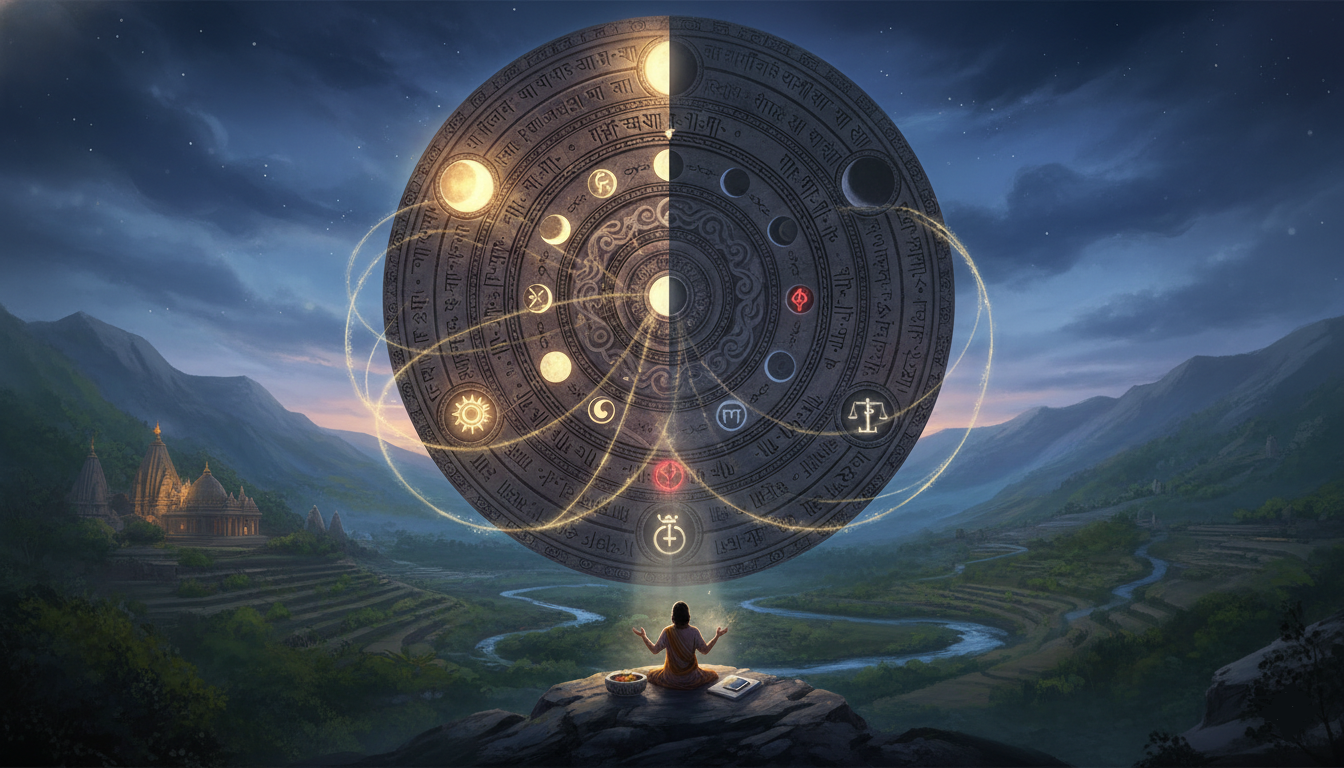
Ever have one of those days where you feel totally in flow? The meeting you scheduled goes perfectly, your creative ideas land, and you get more done in a few hours than you did all last week. Then there are other days where every task feels like a struggle.
What if there was a way to understand the unique energy of each day before it even begins?
In Vedic tradition, there is. It’s called the Panchanga.
The Panchanga (from the Sanskrit pancha-anga, meaning “five limbs”) is the ancient Vedic calendar. It’s like a daily cosmic weather report that describes the quality of time, helping you align your actions with the flow of the universe.
Ancient Wisdom, Modern Application
This guide blends the classical definitions of the Panchanga with contemporary, practical ways to use them for everyday planning. While traditionally used for timing important ceremonies, this framework is also a powerful tool for modern productivity and self-awareness. For formal events like weddings or vows, it’s always best to consult your family tradition and a qualified astrologer.
1. Tithi (The Lunar Day): The Rhythm of Momentum
What it is: The Tithi tracks the Moon’s journey away from the Sun. There are 30 Tithis in a lunar month—15 during the waxing phase (Shukla Paksha) as the Moon grows brighter, and 15 during the waning phase (Krishna Paksha) as it darkens.
How to use it:
- Waxing Moon (growing bigger): The energy is building. This is a supportive time for starting new projects, growth, and expansion.
- Waning Moon (getting smaller): The energy is contracting. This is perfect for finishing tasks, editing, refining, and letting go.
A Deeper Look: Technically, a Tithi marks each 12-degree increment of distance between the Sun and Moon. Because the Moon’s speed changes, a Tithi’s duration can vary, lasting anywhere from 19 to 26 hours.
2. Vara (The Weekday): The Manager of the Day
What it is: The Vara is the day of the week, ruled by a specific planet. Each planetary ruler sets the “managerial tone” for the day.
How to use it: Aligning your tasks with the day’s planetary energy is a simple but powerful practice.
| Day | Ruler | A Supportive Time For… |
| Sunday | Sun | Leadership, setting goals, visibility, self-care. |
| Monday | Moon | Community, nurturing, planning, connecting. |
| Tuesday | Mars | Taking action, tackling hard tasks, exercise. |
| Wednesday | Mercury | Communication, learning, writing, data analysis. |
| Thursday | Jupiter | Strategy, teaching, finances, big-picture thinking. |
| Friday | Venus | Creativity, relationships, marketing, enjoyment. |
| Saturday | Saturn | Deep work, organizing, cleaning, long-term tasks. |
3. Nakshatra (The Lunar Mansion): The Soul of the Day
What it is: This is the heart of the Panchanga. The Nakshatras are the 27 star constellations, or “lunar mansions,” that the Moon passes through. The Nakshatra the Moon is in today describes the day’s core archetype, mood, and personality.
How to use it: Think of the Nakshatra as the day’s unique “character.” To give you a feel for their personalities, here are a few examples from the full system of 27:
- Rohini: Creative and growth-oriented, supportive for planting seeds, starting a business, or launching a product.
- Pushya: Known for its nourishing quality, its energy is ideal for learning, teaching, and acts of service.
- Ashwini: Swift and healing, its energy is great for starting a new health routine or getting a quick start on a project.
4. Yoga (The Energetic Filter): The Tone of the Day
What it is: The Yoga is a special calculation based on the combined positions of the Sun and Moon. There are 27 Yogas, and they act like an energetic filter for the day.
Yoga is computed as ((Sun longitude + Moon longitude) mod 360°) ÷ 13°20′, producing one of 27 nitya yogas. Traditions rate them differently; many are neutral-to-supportive, while several are cautionary. Vyatipata and Vaidhriti are widely treated as inauspicious for auspicious beginnings. On such days, favor introspection, planning, maintenance, or removals over inaugurations.
5. Karana (The Micro-Timing): The “Go” Signal
What it is: The Karana is the smallest unit, representing half of a Tithi. It provides a final layer of nuance for timing your actions within the day. For example, the Vanija karana has commerce connotations, and many practitioners find it supportive for business—not a guarantee, but a useful tie-breaker.
The 7 movable karanas cycle in order—Bava → Balava → Kaulava → Taitila → Gara → Vanija → Vishti (Bhadra)—repeating eight times per lunation. The 4 fixed karanas occur once each month at specific halves: Kimstughna (Shukla Pratipada 1st), Shakuni (Krishna Chaturdashi 2nd), Chatushpada (Amavasya 1st), Naga (Amavasya 2nd).
Vishti (Bhadra) is generally avoided for auspicious inaugurations; it’s powerful for obstacle-clearing, audits, and tough clean-ups.
A Quick Note: Why Panchanga Apps Disagree
You might notice that one app gives slightly different timings than another. This is normal! Different systems use different astronomical calculations (ayanamsas) or define the day differently. Traditional panchangas reckon the day from local sunrise to the next sunrise, so vara, tithi, yoga, and karana may change within the civil day. Modern apps that anchor to midnight can show different boundaries. The key is to pick one reliable source and stay consistent with it.
Putting It All Together: A Simple Daily Practice
- Get a Panchanga App: Find one that feels clear to you.
- Check the Vitals: In the morning, take 60 seconds to look at the day’s Tithi, Vara, and Nakshatra.
- Align One Action: Choose just one thing on your to-do list that feels perfectly aligned with the day’s energy.
What If the Factors Conflict?
A good rule of thumb is to prioritize the day’s energy in this order: Nakshatra (the core story) → Tithi (the momentum) → Karana (the start moment). If a challenging Yoga is active, consider down-scoping your plans rather than canceling them.
Final Thought: Time Isn’t Just a Clock
The Panchanga teaches us that time isn’t a flat line. It has texture, quality, and personality. By learning to read this ancient map, you empower yourself to make wiser choices, reduce friction, and live a life that is more in tune with the beautiful, complex rhythm of the universe.
Leave a Reply